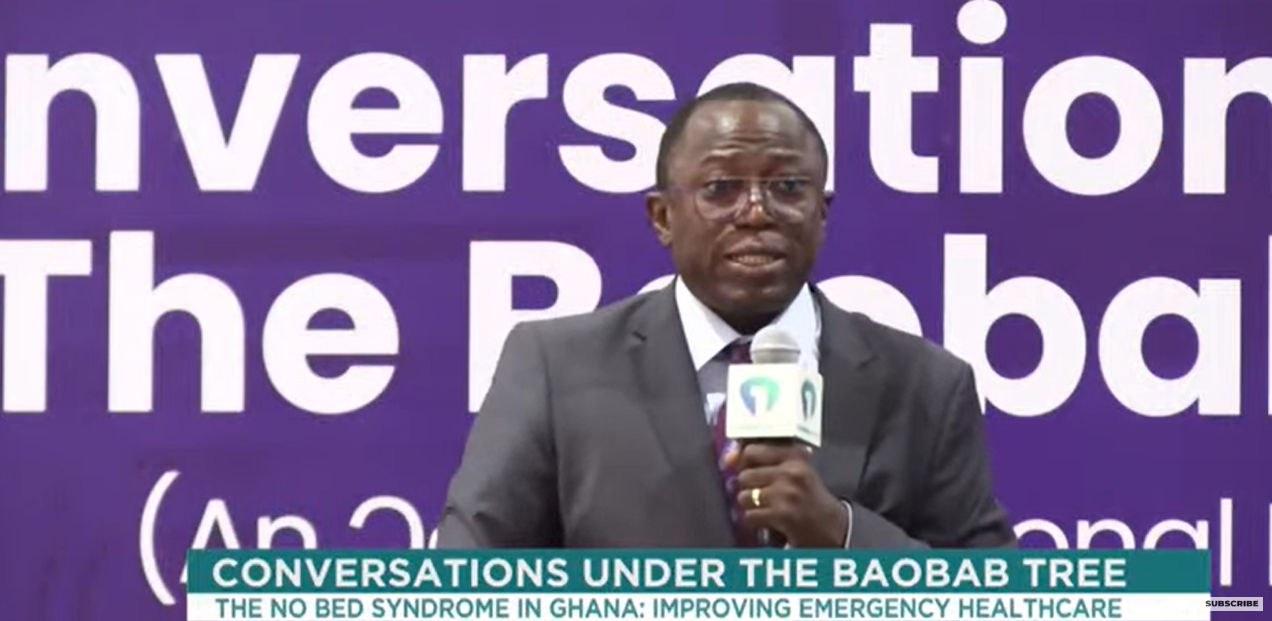
Former Chief Executive Officer of the Korle Bu Teaching Hospital, Dr Opoku Ware Ampomah, has called for a comprehensive health systems approach to address Ghana’s persistent emergency care challenges, warning that piecemeal interventions will not solve the country’s “no bed syndrome.”
Speaking as keynote speaker at the )dade3 Conversations Under the Baobab Tree in Accra on Thursday, April 30, Dr Ampomah stressed that improving emergency healthcare requires coordinated reforms across multiple areas, including governance, staffing, financing, and infrastructure.
“For us to be able to improve our emergency care we need to look at the health systems approach,” he said, explaining that leadership, human resources, service delivery, financing, and data systems all play critical roles in determining outcomes.
He noted that while policies such as the Emergency Care Act exist, their impact remains limited without effective enforcement.
“Those are laws that enable us but those laws must also have teeth to bite and so the enabling legislation must be passed to make sure that we get the benefit of those laws,” he stated.
Dr Ampomah also highlighted governance and management gaps within the healthcare system, stressing the need for stronger strategic leadership and improved monitoring.
“Are we measuring, are we taking notes? Because what gets measured is what gets managed,” he said.
A major concern, he noted, is the country’s severe shortfall in critical care capacity. According to him, Ghana requires about 3,000 critical care beds based on its population, but currently has fewer than 200.
He further explained that each critical care bed requires about nine nurses, underscoring the scale of the human resource gap.
“Do we have enough staff? One of the areas we are falling short is in critical care,” he added.
Beyond infrastructure and staffing, Dr Ampomah pointed to attitudes within the healthcare system as a key but often overlooked factor.
“If you have a few people with the right attitude they can do a lot more than so many people with poor attitude,” he said, stressing the importance of professionalism and commitment in delivering quality care.
He added that improvements in health technology, infrastructure, and basic utilities such as water are equally essential to strengthening emergency response systems.
The event, themed “The No Bed Syndrome in Ghana: Improving Emergency Healthcare,” brought together stakeholders to discuss practical solutions to the country’s ongoing emergency care challenges.
Read also
‘Choke system’ driving Ghana’s no-bed syndrome — Former Korle Bu CEO