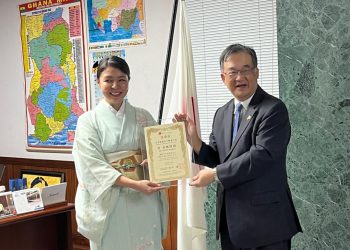
Renowned Japanese scholar Takahiro Morio has highlighted the transformative potential of manga as a powerful tool for education, research and innovation, challenging long-held perceptions that it is merely a form of childish entertainment.
Speaking at a public lecture in Accra on the theme, “Learning from Manga, Learning with Manga, Learning about Manga,” Prof. Morio explained that Japanese comic books and graphic novels offer deep insights into life, society and professional development.
The event, held on March 28, 2026, formed part of a series of engagements organised with support from the Embassy of Japan in Ghana to promote cultural exchange and expand understanding of Japan’s globally influential creative industry.
On education, Prof. Morio described manga as a valuable resource capable of shaping attitudes, careers and life choices. He noted that many works explore professional fields such as medicine, law, manufacturing and hospitality, providing readers with practical knowledge and lessons in discipline, responsibility and teamwork.
He cited examples where manga illustrates complex processes such as aircraft development, enabling readers to understand project management and craftsmanship.
He added that sports and historical manga also inspire young people by influencing career paths and promoting values such as perseverance and peace. Rather than mere entertainment, he stressed that manga functions as a “textbook for life and culture,” educating both young and adult audiences.
Touching on research, Prof. Morio underscored the growing academic interest in manga as a multidisciplinary field spanning literature, sociology, business and technology.
He explained that scholars are increasingly examining how manga evolved into a global cultural force despite relatively limited production budgets compared to Western industries.
According to him, the success of Japanese content lies in its diversity and strong fan communities, which play a crucial role in discovering and promoting works. He emphasised the need to study the entire ecosystem of creators, publishers and audiences to fully understand its global impact.
On innovation, Prof. Morio highlighted the application of manga storytelling techniques in education and problem-solving. He explained that beyond reading, individuals can use manga to create narratives that address real-world challenges such as inequality, environmental degradation and urbanisation.
By focusing on human-centred stories, he said, manga enables a deeper understanding of societal issues while encouraging creative thinking. He therefore advocated its integration into teaching methods to enhance learner engagement and foster innovation.
The Japanese Ambassador to Ghana, Hiroshi Yashimoto, noted that the lecture formed part of the Heart of Japan Storyteller Dispatch Project, aimed at promoting understanding of Japanese culture and strengthening relations between Ghana and Japan ahead of key diplomatic milestones in 2027 including 70 years of diplomatic relations with Japan, 50 years of JICA volunteer dispatch, and 100 years since Dr. Hideyo Noguchi’s visit.