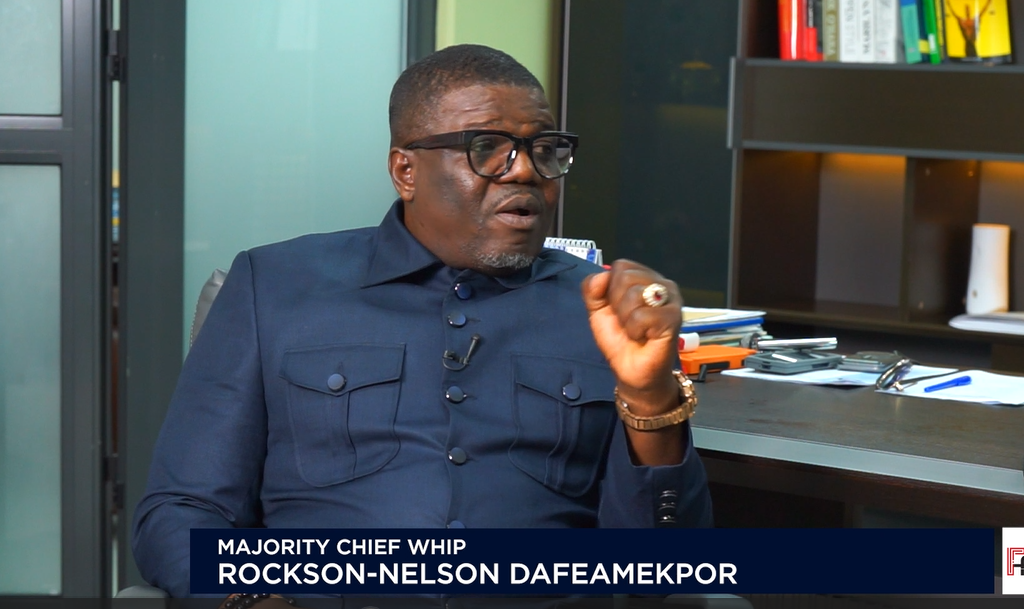
The Majority Chief Whip, Rockson-Nelson Dafeamekpor, has stated that prospective students seeking admission to the Ghana School of Law will no longer be required to sit for entrance examinations under the newly passed Legal Education Reform law.
Speaking on Eyewitness News on Monday, May 11, Dafeamekpor dismissed reports suggesting candidates would sit for entrance examinations in July, insisting that the new law had abolished the system.
According to him, a circular announcing the examinations was not approved by the Independent Examination Committee and was circulated without proper authorisation.
He further alleged that some lawyers had turned the entrance examination process into a money-making venture by organising paid preparatory classes for prospective law students.
Dafeamekpor argued that the decision to abolish the entrance examination regime had triggered opposition from individuals who financially benefited from the arrangement.
“Some colleague lawyers have turned their entrance examination into a commercial activity. They are fleecing prospective professional law students by pretending that they are organising extra classes towards the exams,” he alleged.
However, former Director of the Ghana School of Law, Kwaku Ansa-Asare, has clarified that entrance examinations for prospective law students will still be conducted this year despite President John Dramani Mahama assenting to the Legal Education Reform Bill, 2025.
According to Mr. Ansa-Asare, claims that the new law immediately abolishes this year’s entrance examinations are inaccurate, stressing that the General Legal Council still retains the authority to organise the process under the existing legal framework.
He explained that the newly passed legislation does not automatically invalidate current arrangements governing legal education admissions.
“Under the new bill that has just been signed into law, the Act does not squash the existing law, and therefore the General Legal Council can still go ahead to organise entrance exam,” he said.
The conflicting positions come after President Mahama signed the Legal Education Reform Bill, 2025, into law, effectively ending the 66-year monopoly of the Ghana School of Law over professional legal training and allowing accredited institutions to offer professional law courses.
The legislation is expected to expand access to legal education in Ghana following years of concerns over limited admissions, restrictive entry requirements and the competitive nature of the Ghana School of Law entrance examinations.