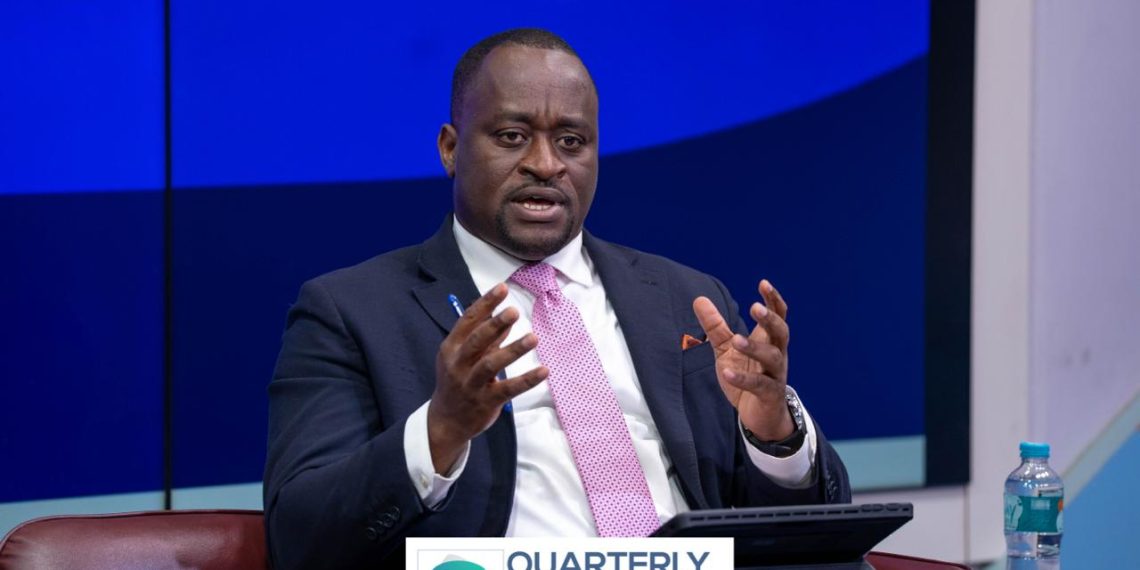
Dr Theo Acheampong, Technical Advisor at the Ministry of Finance, says his confidence in the International Monetary Fund’s (IMF) Policy Coordination Instrument (PCI) is grounded in the country’s past experiences with IMF programmes and the lessons drawn from them.
Speaking on Channel One TV’s The Point of View on Monday, May 18, he explained that Ghana’s engagement with IMF-supported programmes since 1966, particularly the most recent arrangements, shows the need for a strong policy anchor even in periods of relative economic stability.
He noted that discussions around the 2019 programme highlighted how countries may not only seek IMF support for financing, but also for credibility, external visibility, and discipline to manage election-related fiscal pressures.
“Really, it’s learning from that history and also learning from the fact that you have been able to stabilise the economy now and you want to do a few other things that are slightly different and you still need the assistance of the Fund from a technical angle to help you implement it,” he said.
Dr Acheampong explained that the PCI is expected to support ongoing reforms in key areas such as state-owned enterprises and central bank operations, while also strengthening policy credibility in the eyes of investors, credit rating agencies, and the public.
He added that the framework provides space for government to pursue fiscal adjustments, including plans to increase development-related spending by easing the primary balance, while maintaining debt sustainability.
According to him, the PCI is not a bailout or a lending programme, but a technical assistance framework designed to guide reforms and ensure they are effectively implemented for long-term benefit.
“So what is important here is that this is not a bailout. We are not taking money. It is also not a programme. It is actually technical assistance,” he stated.
He further pointed to international examples, noting that countries such as Rwanda and Cape Verde have used similar IMF arrangements alongside additional support tools to advance reforms in areas like state-owned enterprises and climate-related spending, with positive outcomes.
Dr Acheampong said Ghana’s approach reflects the need for a policy anchor that bridges short-term economic stabilisation with long-term development goals, especially as the country transitions from crisis management to reform consolidation.
He added that the PCI will be complemented by a broader national economic programme announced by the Finance Minister, aimed at strengthening Ghana’s reform agenda going forward.
Meanwhile, the IMF has said that Ghana’s proposed PCI programme is expected to run for 36 months, with completion projected around mid-2029.
Speaking at a press conference on Friday, May 15, the IMF Mission Chief for Ghana, Ruben Atoyan, said Ghana’s request for the new PCI arrangement will be presented to the IMF Executive Board by the end of July 2026.
According to him, the Executive Board’s approval process will coincide with the completion of Ghana’s final review under the current Extended Credit Facility (ECF) programme.
“With the time frame for the PCI as explained, it is a 36-month PCI. We plan to take the request for PCI to the IMF Executive Board at the end of July, at the same time as the final review on the ECF,” Mr Atoyan stated.
“So both the final review of the ECF will be completed, and the new PCI will be initiated going forward, and within 36 months, we hope to complete the PCI sometime in the middle of 2029,” he added.
Read also
Mahama gov’t’s IMF-PCI decision a master stroke – Franklin Cudjoe