


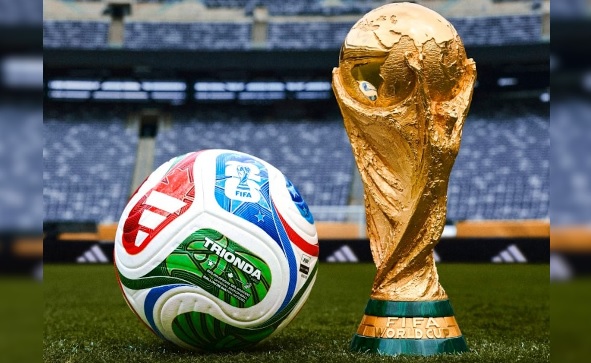
Broadcast journalist and co-host of the Citi Breakfast Show, Godfred Akoto Boafo, has described the 2026 FIFA World Cup as potentially one of the most complicated tournaments in the competition’s history, citing geopolitical tensions, visa requirements and the high cost of travel across three host nations.
Speaking on The Point of View on Channel One TV on Wednesday, June 10, Akoto Boafo said the unique nature of the tournament, which is being hosted jointly by the United States, Canada and Mexico, presents challenges not faced by previous World Cups.
“It’s perhaps one of the most complicated World Cups that we’re ever going to have,” he said.
According to him, when the tournament was awarded to the three North American countries, many expected it to be a landmark event. However, shifting political relations among the host nations have complicated the landscape.
“Well, it’s just the period of uncertainty that we live in and when this World Cup was awarded to the three countries, everybody was like, ooh, it’s going to be an amazing World Cup.
“But the past two and a half years or so, since, of course, the coming into office of the current US President Donald Trump has seen a ratcheting up of, one would say hostilities, but there’s been a bit of a cold war brewing.
“So the United States and Canada are not on the best of terms, the United States and Mexico are also not on the best of terms. And that has made this particularly difficult.”
Akoto Boafo also pointed to the logistical difficulties facing supporters because of the tournament’s expanded format and the need to travel across multiple countries.
He noted that fans may be required to secure visas for more than one country, adding another layer of complexity to attending matches.
“Now, to get access, it means that you have to get a visa into three countries. You need to get a US visa, you need to get a Canada visa. Now, if you’re a multiple entry holder to the US, you can get into Mexico. But obviously, Canada is a much different affair.”
He argued that the geographical spread of the tournament and the cost of moving between host cities have made attending matches significantly more expensive than in previous editions.
“The sheer matter of cost” is another major concern, he said, pointing to rising transportation, accommodation and ticket prices.
According to him, some premium match tickets have become unaffordable for ordinary supporters.
“Some Category A games, let’s take Ghana versus England, Tier 1 tickets are going for $1,800. For the average football fan, how is it coming up with that sort of money in addition to travel costs, in addition to hotel costs, in addition to feeding costs, in addition to transportation within any of these three countries.”
Akoto Boafo said the experience differs sharply from traditional World Cups, where host venues are generally located within easier travelling distance and supporters can move around more conveniently.
“This is completely different,” he said.
Drawing from his own experience covering the tournament, he cited the cost of domestic travel within the United States as an example of the financial burden facing fans and journalists alike.
“Like I was telling you, I have to go to Rhode Island tomorrow morning, which is where the Black Stars will be. And airfares are at $350 plus, that is minus luggage.
“So if I’m adding my luggage, basically, I’m looking at $500 plus to move from Virginia to watch the Black Stars train in Rhode Island. How many people can afford that?”
He added that while cheaper alternatives exist, they often come at the cost of long and exhausting journeys.
“If I decide to go by bus, it’s a nine-hour trip. It’s not easy. So either it’s too expensive, or you go the cheap way and also get too tired.”
For Akoto Boafo, the combination of political tensions, complex travel arrangements and soaring costs has transformed what is traditionally a celebration of football into a significantly more demanding experience for supporters.
“So it’s perhaps one of the most complicated World Cups that we’re ever going to have,” he reiterated.
The 2026 FIFA World Cup kicks off at the iconic Azteca Stadium in Mexico City on Thursday, June 11 and culminates with the final at MetLife Stadium near New York City on July 19.
The expanded tournament will feature 48 nations competing in a record 104 matches across Canada, Mexico and the United States over 39 days.