The Upper East Region is preparing to make history.
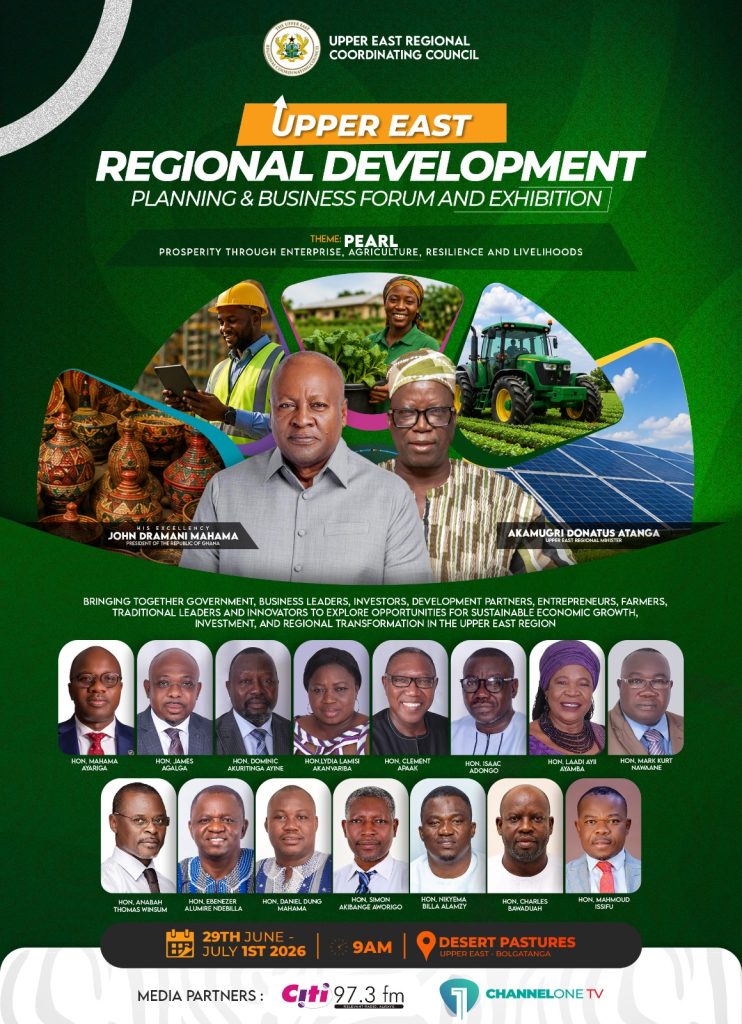
From June 29 to July 1, 2026, Bolgatanga will host the maiden Upper East Regional Development and Business Forum and Exhibition under the theme, “Prosperity through Enterprise, Agriculture, Resilience, and Livelihoods,” a landmark initiative expected to redefine the development trajectory of one of Ghana’s most resilient and resource-rich regions.
The event will bring together policymakers, investors, development partners, traditional authorities, business leaders, entrepreneurs, academics, members of the Ghanaian diaspora, and civil society organisations to shape a common vision for the future of the region.
With Citi FM and Channel One TV serving as official media partners, national attention is turning to a region that has long been recognised for its agricultural strength, strategic location, entrepreneurial spirit, and rich cultural heritage, yet remains one of the country’s least industrialised economic frontiers.
The PEARL Vision
At the centre of the forum is the launch of the PEARL Framework (2026–2035), a 10-year strategic development blueprint designed to mobilise approximately GH¢8.6 billion in public and private investment for the Upper East Region. The framework seeks to transform the region through enterprise development, agro-industrialisation, investment promotion, trade expansion, resilience building, and sustainable livelihoods.
PEARL—Prosperity through Enterprise, Agriculture, Resilience, and Livelihoods—represents a deliberate shift from identifying development challenges to implementing practical solutions that unlock economic opportunities and create jobs.
According to the Upper East Regional Minister, Donatus Akamugri Atanga, the framework is intended not merely as a policy document but as an investment prospectus showcasing the region’s comparative advantages to local and international investors.
The initiative is being coordinated by the Upper East Regional Coordinating Council in partnership with the Importers and Exporters Association of Ghana and supported by a technical working committee comprising professionals and development experts from various sectors.
Why the Upper East Matters
The Upper East Region occupies a unique position within Ghana’s economic geography. Bordering Burkina Faso and Togo, it serves as a gateway to the Sahel and the wider West African market. The region possesses significant agricultural resources, vibrant cross-border trade networks, emerging tourism opportunities, mineral resources, and a growing entrepreneurial ecosystem.
Agriculture remains the backbone of the regional economy. Recent government interventions have led to increased cultivated acreage, improved staple crop production, expanded irrigation initiatives, and greater support for farmers through mechanisation and input distribution programmes. Thousands of acres of potentially irrigable land have also been identified for commercial agricultural development.
The region is increasingly being recognised as a strategic location for agro-processing, agribusiness development, livestock production, renewable energy investment, and green enterprise initiatives. Programmes such as the GreenGrowth Ghana Project are already supporting skills development, enterprise growth, and sustainable economic opportunities for women and youth.
Yet significant challenges remain. Infrastructure deficits, climate vulnerability, youth unemployment, limited industrialisation, and underinvestment continue to constrain economic growth. The PEARL Framework seeks to confront these challenges head-on through a coordinated, long-term development strategy.
Ten Strategic Pillars for Transformation
The PEARL Framework identifies 10 priority sectors expected to drive economic transformation over the next decade.
These include:
- Agriculture and Agribusiness Development
- Manufacturing and Value Addition
- Mining and Mineral Resource Development
- Trade and Commerce
- SME Development and Entrepreneurship
- Tourism and Cultural Industries
- Infrastructure Development
- Human Capital Development
- Environmental Sustainability
- Investment Promotion and Private Sector Growth
These sectors have been selected to stimulate economic diversification, attract investment, create jobs, and improve livelihoods across all districts and municipalities in the region.
A Platform for Investment and Partnerships
The three-day forum is expected to feature high-level policy discussions, investment presentations, business-to-business engagements, exhibitions, networking sessions, and strategic dialogues focused on unlocking opportunities within the region.
Organisers believe the event will serve as a catalyst for attracting domestic and international investors interested in agriculture, renewable energy, tourism, manufacturing, mining, infrastructure, logistics, and digital innovation.
More importantly, the forum seeks to foster partnerships among government, the private sector, development institutions, academia, traditional authorities, and local communities to ensure sustainable and inclusive growth.
The event also aligns with broader national development priorities, including economic transformation, job creation, private sector development, and regional industrialisation.
A Non-Partisan Development Agenda
One of the defining features of the PEARL initiative is its emphasis on non-partisanship.
Regional authorities have consistently stressed that the future development of the Upper East Region transcends political affiliations. The framework is intended to serve as a shared development agenda that remains relevant regardless of changes in political leadership.
This approach has received support from various stakeholders who view long-term planning and investment continuity as essential ingredients for sustainable development.
Beyond a Forum
The significance of the PEARL Framework extends beyond the three-day event.
If successfully implemented, the initiative could position the Upper East Region as one of Ghana’s leading destinations for investment, enterprise development, agro-industrial growth, and cross-border trade.
For a region historically known for its resilience, innovation, and hardworking people, PEARL offers an opportunity to transform potential into prosperity.
As government officials, investors, businesses, traditional leaders, and development partners converge on Bolgatanga, expectations are high that the forum will mark the beginning of a new chapter—one in which the Upper East Region emerges not merely as a beneficiary of development but as a major driver of Ghana’s economic future.
The message from Bolgatanga is clear: the Upper East is open for business, ready for investment, and determined to chart its own course towards prosperity.