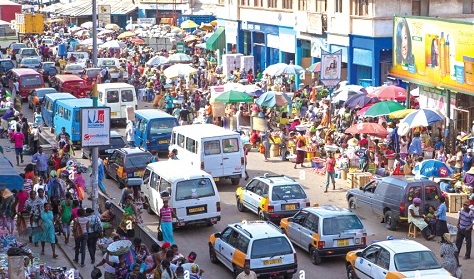
The steady migration of thousands of Ghanaians to Accra is driven less by personal preference than by economic necessity, according to a new policy proposal by EM Advisory Limited, which argues that the country’s uneven distribution of employment opportunities is the primary force behind the capital’s persistent congestion.
In its presentation titled Decongest the Economy, Decongest Accra: A Tri-Pole Economy Model for Ghana, the policy advisory firm contends that internal migration patterns reveal a straightforward reality: people relocate to where jobs are available. Until Ghana deliberately creates strong employment opportunities outside Greater Accra, it says, migration to the capital will continue regardless of worsening traffic, rising living costs and mounting pressure on infrastructure.
“People move to where the work is,” the presentation states, using that simple observation to explain decades of population movement from other regions into the national capital.
According to EM Advisory, discussions about Accra’s congestion often focus on roads, drainage systems, housing and transport. While those issues are important, the report argues that they represent the consequences rather than the cause of the problem. The underlying driver, it says, is the concentration of economic activity and employment within one metropolitan area.
A city built around opportunity
For many young Ghanaians, particularly those completing school or searching for better-paying jobs, Accra represents the country’s largest marketplace for opportunity. It hosts the headquarters of major companies, financial institutions, multinational firms, government agencies and a large proportion of Ghana’s formal private sector.
The report notes that this concentration has turned Greater Accra into Ghana’s dominant employment destination, attracting workers from virtually every region of the country.
According to migration data cited in the presentation, more than 70 percent of people moving to Accra do so for employment or economic survival. EM Advisory says this finding challenges the common perception that migration is driven primarily by urban lifestyles or the attractions of city life.
Instead, it argues, most migrants are responding to the limited availability of jobs in their home regions.
“The north sends its youth south not because Accra is comfortable, but because home offers fewer jobs to keep them,” the presentation states.
The report says that understanding this distinction is critical because it changes how policymakers should approach the issue. If employment remains concentrated in Accra, investments in roads, housing and drainage alone are unlikely to reduce congestion over the long term.
Understanding the employment-pull gap
A central concept introduced by EM Advisory is what it calls the “employment-pull gap”—the difference between a region’s share of national employment and its share of the country’s working-age population.
A positive employment-pull gap indicates that a region provides more jobs than its population share would ordinarily suggest, making it an attractive destination for job seekers. A negative gap, on the other hand, suggests that employment opportunities are insufficient relative to the number of people available to work.
According to the presentation, Greater Accra records Ghana’s largest positive employment-pull gap at approximately two percentage points, placing it well ahead of every other region.
In practical terms, this means the capital absorbs a disproportionately high share of the country’s available employment opportunities, reinforcing its position as the nation’s economic centre.
Meanwhile, several regions—particularly in northern Ghana—record significant negative employment-pull gaps.
Upper East has the country’s largest employment deficit at minus 1.4 percentage points, followed by Northern and Upper West at minus 0.7 each. North East records minus 0.6, while Savannah stands at minus 0.5.
EM Advisory says these figures indicate that many residents in those regions face far fewer employment opportunities than their numbers would require.
Regional unemployment tells the same story
The report argues that unemployment data further supports its findings.
Savannah Region records Ghana’s highest unemployment rate at 22.4 percent, followed by Upper East at 21.1 percent and North East at 20.7 percent. The Upper West and Northern regions also rank among those with the highest unemployment levels nationally.
By comparison, Greater Accra’s unemployment rate stands at 12.9 percent—still close to the national average despite accommodating nearly one-fifth of Ghana’s population.
According to EM Advisory, this demonstrates the remarkable ability of the capital’s economy to absorb labour, even as thousands of additional job seekers continue arriving each year.
The report argues that these regional disparities create a powerful incentive for migration. For many young people, relocating to Accra is not necessarily a choice between rural and urban life; it is a choice between limited economic prospects at home and greater chances of employment elsewhere.
Economic consequences beyond Accra
While Greater Accra continues to attract workers, the report suggests that the migration trend has wider implications for national development.
Communities that consistently lose young people to migration may experience slower economic growth, shrinking local markets and reduced entrepreneurial activity. Businesses operating outside major urban centres may struggle to recruit skilled workers, while local governments face difficulties expanding their tax base and sustaining investment.
Conversely, the continuous inflow of migrants into Accra increases demand for housing, transportation, healthcare, schools and other public services. It also contributes to the growth of informal settlements as many new arrivals search for affordable accommodation close to employment opportunities.
EM Advisory argues that these pressures should not be viewed as isolated urban problems but as the direct outcome of an economy that has become increasingly concentrated in one geographical location.
A different path forward
Rather than attempting to discourage migration through administrative measures, EM Advisory believes Ghana should address the economic conditions that make migration inevitable.
The presentation proposes the creation of a Tri-Pole Economy Model that would distribute industries, public investment and employment opportunities across multiple economic centresrather than allowing Accra to remain the country’s overwhelming destination for growth.
The firm argues that stronger regional economies would enable young people to pursue careers closer to their communities while reducing the pressure currently placed on the capital.
Businesses, it says, would benefit from access to new markets and labour pools, while government could achieve more balanced national development by directing infrastructure and industrial investment to areas with untapped economic potential.
According to EM Advisory, Ghana’s long-term competitiveness depends not only on improving Accra but also on ensuring that prosperity is created across the country. As long as employment remains concentrated in one city, the report concludes, migration will continue—and with it, the congestion challenges that have become synonymous with the national capital.