Before dawn breaks at many of Ghana’s border communities, a network of small traders, transport operators and market sellers begins moving goods through routes that rarely appear in official trade records.
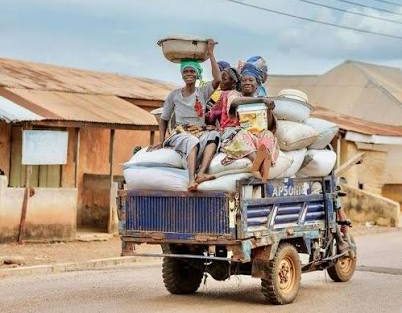
Their main tool is not the heavy truck or container vehicle associated with international commerce, but the humble tricycle, locally known as ‘aboboyaa’, a small transport vehicle that has become a key driver of Ghana’s growing informal cross-border trade economy.
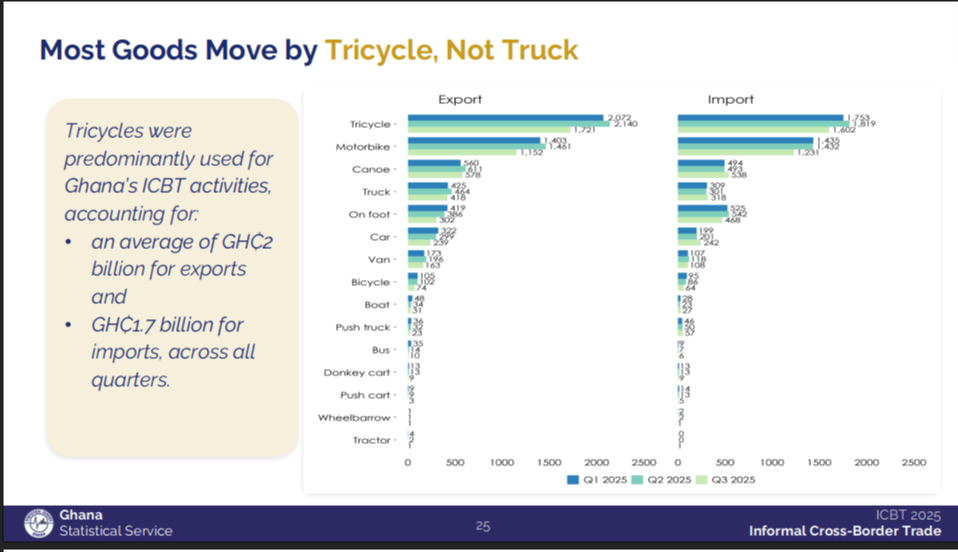
Data from the Ghana Statistical Service (GSS) shows that tricycles accounted for a significant share of goods moved through informal border channels between January and September 2025, carrying an average of about GH¢2 billion worth of exports and GH¢1.7 billion worth of imports across the period.
 The finding is part of Ghana’s first comprehensive effort to measure informal cross-border trade, which revealed that unrecorded trade with neighbouring countries reached GH¢31 billion in the first three quarters of 2025.
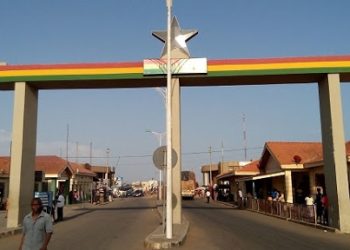
The survey covered 206 active border points linking Ghana with Togo, Burkina Faso and Côte d’Ivoire, capturing goods that move outside official customs records through small-scale trading activities.
Unlike formal trade, which is often dominated by large companies and commercial transport systems, informal trade is driven largely by individuals moving smaller quantities of goods frequently across borders.
For many traders operating in border communities, tricycles provide a cheaper and more flexible means of transporting goods between markets, farms and crossing points.
The dominance of tricycles highlights the structure of Ghana’s informal economy — one built around thousands of small transactions rather than a few large shipments.
The GSS said the data provides a clearer picture of an economic sector that has long supported livelihoods but remained largely invisible in official statistics.
“Counting it is the first step to strengthening it,” the service said, noting that better measurement would help policymakers design interventions that support traders while improving economic planning.
The survey found that informal trade was especially significant in Ghana’s commerce with its neighbours. Informal transactions accounted for a majority of trade with Togo and Côte d’Ivoire, showing the importance of small-scale cross-border activity in regional commerce.
Beyond moving goods, the informal trade system supports communities along Ghana’s borders, where many households depend on trading activities for income.
The GSS recommended making registration and licensing easier for small, high-frequency traders, improving infrastructure at busy crossings and designing financial services that meet the needs of both women and men engaged in cross-border trade.
The service also called for stronger coordination between the Ghana Statistical Service, Ghana Revenue Authority and Immigration Service to ensure border trade data is captured more effectively.
As Ghana seeks to deepen regional integration under the African Continental Free Trade Area (AfCFTA), the tricycle economy offers a reminder that much of Africa’s trade does not happen through large ports and warehouses, but through thousands of small traders moving goods every day across shared borders.