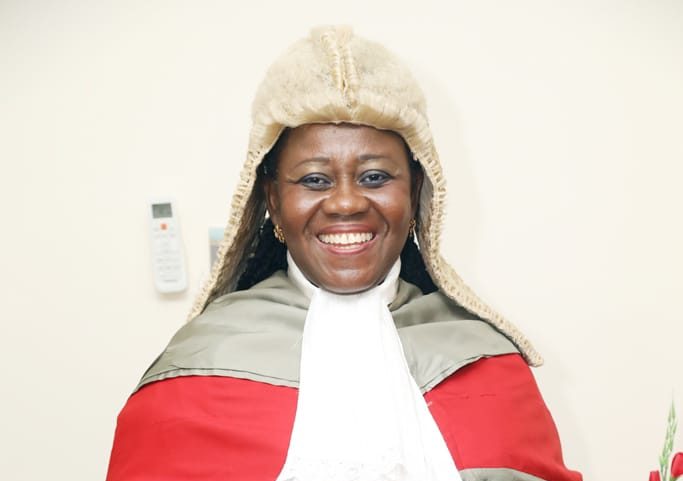
The Supreme Court dismissed two consolidated lawsuits challenging the process used to suspend and investigate former Chief Justice Gertrude Araba Esaaba Sackey Torkornoo, ruling that President John Dramani Mahama acted within the bounds of the Constitution when he triggered her removal proceedings without first inviting her to contest the petitions against her.
In a judgment authored by Justice I. O. Tanko Amadu and delivered on July 2, 2026, a five-member panel of the apex court comprising Amadu JSC (presiding), Kulendi, Kwofie, Dzamefe and Amaleboba JSC — held that neither the absence of an “antecedent hearing” before the President’s prima facie determination, nor the absence of a published Constitutional Instrument regulating the removal process, rendered the suspension or the committee of inquiry unconstitutional.
“The consolidated action fails and is accordingly dismissed,” the Court ruled.
How the case began
The dispute traced back to March 2025, when the Presidency announced that Mahama had received three separate petitions calling for Torkornoo’s removal as Chief Justice and had forwarded them to the Council of State to begin the consultation process required under Article 146(6) of the Constitution.
Torkornoo responded by writing to the President, invoking her right to a fair hearing and asking for copies of the petitions along with an opportunity to respond before any determination was made on whether they disclosed a prima facie case. The Secretary to the President supplied her with the petitions and gave her ten days to respond. She did so, and her responses were forwarded to the Council of State alongside the petitions.
By April 22, 2025, following consultation with the Council of State, the President determined that each petition disclosed a prima facie case, empanelled a five-member committee of inquiry under Article 146(6), and suspended Torkornoo with immediate effect pending the outcome of that inquiry.
Two separate lawsuits followed. Vincent Ekow Assafuah, represented by lawyer Godfred Yeboah Dame, argued that the Constitution required the President to notify the Chief Justice and obtain her comments before even beginning consultations with the Council of State, not merely before the committee of inquiry. Theodore Kofi Atta-Quartey, represented by Alhaji Farouk Seidu, argued something different: that the entire removal mechanism could not lawfully be activated at all without a published Constitutional Instrument spelling out how the President’s discretion, the Council of State’s role, and the committee’s proceedings should work.
Why the Court rejected the fair-hearing argument
The Court agreed that anyone facing removal from judicial office — the Chief Justice, any Supreme Court justice, or other protected constitutional office holders is entitled to be heard. But it held that the Constitution deliberately places that hearing at a specific stage: before the committee of inquiry itself, under Article 146(8), not before the President’s preliminary screening.
The judges drew a direct comparison to the standard used in criminal trials, where a judge ruling on a “case to answer” decides only whether the evidence is strong enough to proceed to trial not whether the accused is guilty. In the same way, the Court reasoned, when the President determines that a petition against the Chief Justice discloses a prima facie case, he is not deciding whether she is guilty of misconduct or incompetence. He is deciding only whether the allegations, if true, are serious enough to warrant a full inquiry.
Importing a full hearing into that earlier screening stage, the judges said, would blur the line between asking whether there is a case to investigate and actually deciding the case, a confusion the Constitution’s framers took care to avoid. The real, substantive hearing, complete with the right to respond, be represented and challenge evidence, comes later, at the committee stage.
Why the “published instrument” argument also failed
On the second challenge, the Court held that Article 146 of the Constitution is “self-executing,” meaning it does not need a separate law or regulation to bring it into force. The article already spells out who acts (the President, the Council of State, and the committee of inquiry), how the committee should be composed, and what protections apply once the inquiry begins, including the Chief Justice’s right to a hearing and the requirement that proceedings be held in private.
The judges warned that accepting the opposite argument would be dangerous: if constitutional powers only worked once Parliament or the Executive got around to writing implementing rules, the actions of government could be permanently held hostage to legislative inaction. Under that logic, a Chief Justice who had “demonstrably fallen into grave misbehaviour” could never be removed simply because no regulation had yet been published, a outcome the Court said “cannot be the law.”
The Court did acknowledge that clearer rules would be an improvement and said it shared past concerns raised by other justices about how thin the procedural detail in Article 146 really is. But it said fixing that gap is a job for Parliament or a future constitutional amendment, not something courts should invent by reading requirements into the Constitution that were never written there.
The bottom line
Because the Court found no breach of the Constitution at any stage of the process, it held there was nothing left to nullify, not the President’s prima facie determination, not the constitution of the inquiry committee, and not Torkornoo’s suspension. All of it, the Court ruled, was carried out in conformity with the Constitution, and the consolidated lawsuits were dismissed in their entirety.