



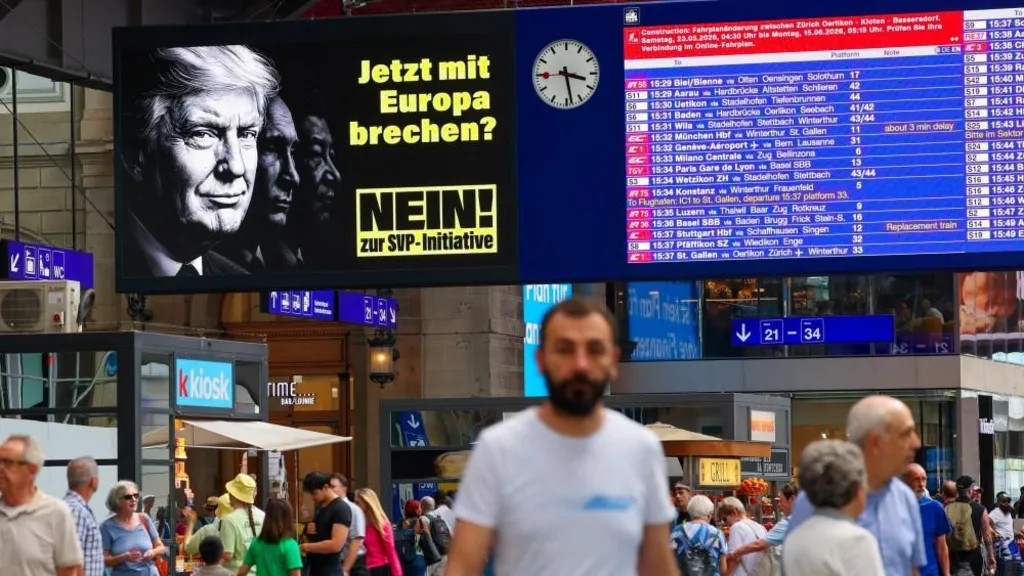
Switzerland will hold a nationwide referendum on Sunday, June 14, on a proposal backed by the right-wing Swiss People’s Party to cap the country’s population at 10 million by 2050, a move supporters say will ease pressure on housing, public services and the environment, but which opponents warn could worsen labour shortages and strain relations with the European Union.
Dubbing it a “chaos initiative”, the government, other political parties, business leaders and trade unions argue the proposal will deprive hospitals and hotels of much-needed staff and damage hard-won relations with the European Union, potentially leaving non-EU member Switzerland isolated in an increasingly uncertain global environment.
The vote comes amid rapid population growth in Switzerland. The country’s population has increased from 7.3 million in 2002 to 9.1 million today, with 27% of residents born outside the country.
Under Switzerland’s system of direct democracy, major policy decisions can be put to a nationwide vote once campaigners secure 100,000 signatures. Concerns over overcrowded trains, rising housing costs and increasing health insurance premiums have helped push the issue to the forefront of national debate.
Opinion polls suggest the referendum could be decided by a narrow margin. While recent surveys indicate 52% of voters oppose the proposal and 45% support it, a sizeable number of voters remain undecided ahead of the vote.
The referendum has exposed deep divisions over immigration, with supporters and opponents offering sharply contrasting views on the causes of Switzerland’s social and economic challenges.
Nils Fiechter, a representative of the Swiss People’s Party in Bern’s cantonal parliament, argues that unchecked immigration is placing excessive pressure on housing, schools, transport systems and social services.
“We have lost control,” he said, warning that continued immigration risks fundamentally changing Switzerland’s identity.
However, Helin Genis, a Social Democrat and member of Bern’s city council, rejected the argument that migrants are responsible for the country’s challenges.
“It is not migrants who determine rent levels. It is not migrants who raise health insurance premiums. Nor is it migrants who make political decisions on housing, infrastructure or social investment,” she told BBC News.
Genis argued that viewing national challenges solely through the lens of migration risks creating division rather than solutions.
A major question facing undecided voters is how a population cap would be implemented. While no country has imposed a fixed limit on its total population, the Swiss proposal would require the government to intervene once the population reaches 9.5 million and ensure it does not exceed 10 million before 2050.
Potential measures could include restricting asylum approvals and ending family reunification rights for foreign workers.
Critically, if the population cap is reached, Switzerland would be required to terminate international agreements that conflict with the target, including the European Union’s free movement of people arrangement.
That prospect has alarmed business leaders and economists, who fear it could undermine Switzerland’s economic relationship with its largest trading partner.
Economiesuisse chief economist Rudolf Minsch warned that approval of the initiative could create significant challenges in Switzerland’s relations with the European Union.
“The EU is still by far the most important trading partner for Switzerland,” he said, stressing the importance of maintaining stable and predictable ties with Brussels.
Swiss employers have also expressed concern about labour shortages. Foreign workers account for roughly half of all employees in the country’s hotel sector, while hospitals and care homes remain heavily dependent on immigrant labour.
Supporters of the initiative insist that limiting immigration would reduce pressure on public infrastructure and services. Opponents, however, argue that such claims overlook Switzerland’s ageing population, with around 20% of residents now aged over 65.
They contend that younger workers and taxpayers, many of whom come from abroad, are essential to supporting the country’s economy and welfare system.
Jon Pult, a Social Democratic member of parliament, warned that the proposal could leave Switzerland increasingly isolated at a time of growing global uncertainty.
His concerns come as Europe faces heightened security challenges, rising energy costs linked to conflicts in Ukraine and Iran, and growing trade tensions with the United States.
Pult argued that jeopardising agreements with the European Union could weaken Switzerland’s international standing and reduce goodwill from its European partners.
Fiechter dismissed those concerns as fearmongering, insisting that continued cooperation remains in the interests of both Switzerland and the European Union.
Nevertheless, concerns about isolation appear to be influencing the campaign. Posters opposing the initiative warn against breaking ties with Europe, portraying a world increasingly shaped by geopolitical uncertainty and trade disputes.
Supporters maintain that the proposal is ultimately about protecting Switzerland’s quality of life.
“Anyone who loves Switzerland, whether with or without a migrant background, wants it to remain a place worth living in, safe and prosperous. That is exactly what this initiative is about,” Fiechter said.
But Genis remains unconvinced, arguing that Switzerland’s challenges require investment in housing, public services and working conditions rather than restrictions on immigration.
“That’s why I am convinced this initiative does more harm than good to Switzerland,” she said.