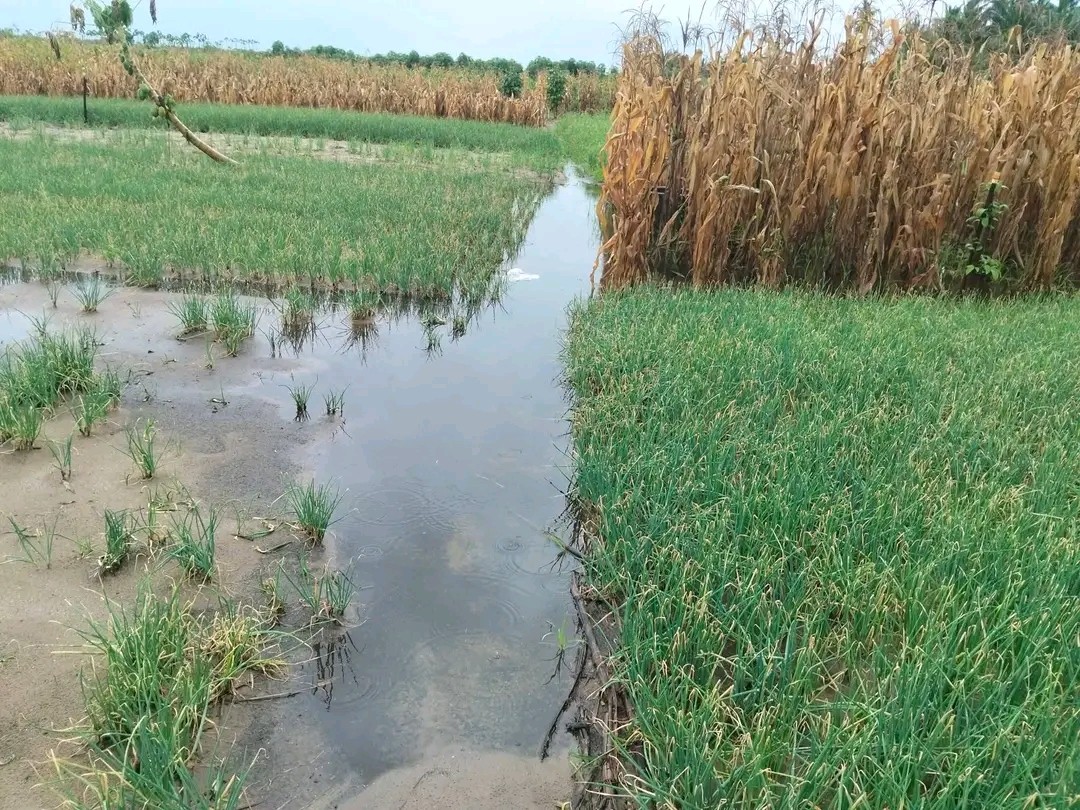
Acres of farmland in some communities within the Anloga District of the Volta Region have been submerged following rising floodwaters, triggering panic among farmers who depended entirely on crops cultivated on low-lying areas.
Residents and farmers who spoke to the Ghana News Agency (GNA) reported that water levels were rising steadily across many farming communities, where crops planted on raised beds were visibly underwater, with imminent destruction expected within weeks if the inundation continued at the current pace.
Obed Deladem Fomevor, a farmer at Dzita, described scenes of helplessness as crops planted with their savings, labour, and hope slowly disappeared beneath advancing floodwaters.
“We have invested heavily in seedlings and fertilisers, but as you can see, our inputs for the current season are going away, and we are now losing everything,” he said.
He stated that the potential losses threaten more than a seasonal income decrease.
He warned that harvests destroyed would leave families unable to meet basic needs, including school fees, healthcare costs, and daily sustenance, which would deepen poverty in already vulnerable communities.
Fomevor expressed frustration that flooding of Dzita farmlands was not new and said that the same communities suffer identical agricultural losses year after year, yet no sustainable structural solution has been implemented by the authorities to address the root causes of recurring inundation.
“Our long-standing demand from the farmers and opinion leaders is the urgent dredging of the Keta Lagoon. The dredging will allow excess water with nowhere to drain to flow freely into the lagoon, and it will reduce hydraulic pressure on farmlands and residential areas.” he added.
He emphasised that agriculture is the backbone of life in Anloga District as well as the whole country, which feeds families, generates incomes, sustains local markets, and anchors the social and economic fabric of communities, and continued failure to protect farmlands amounts to systemic neglect of the rural areas.
Source: GNA