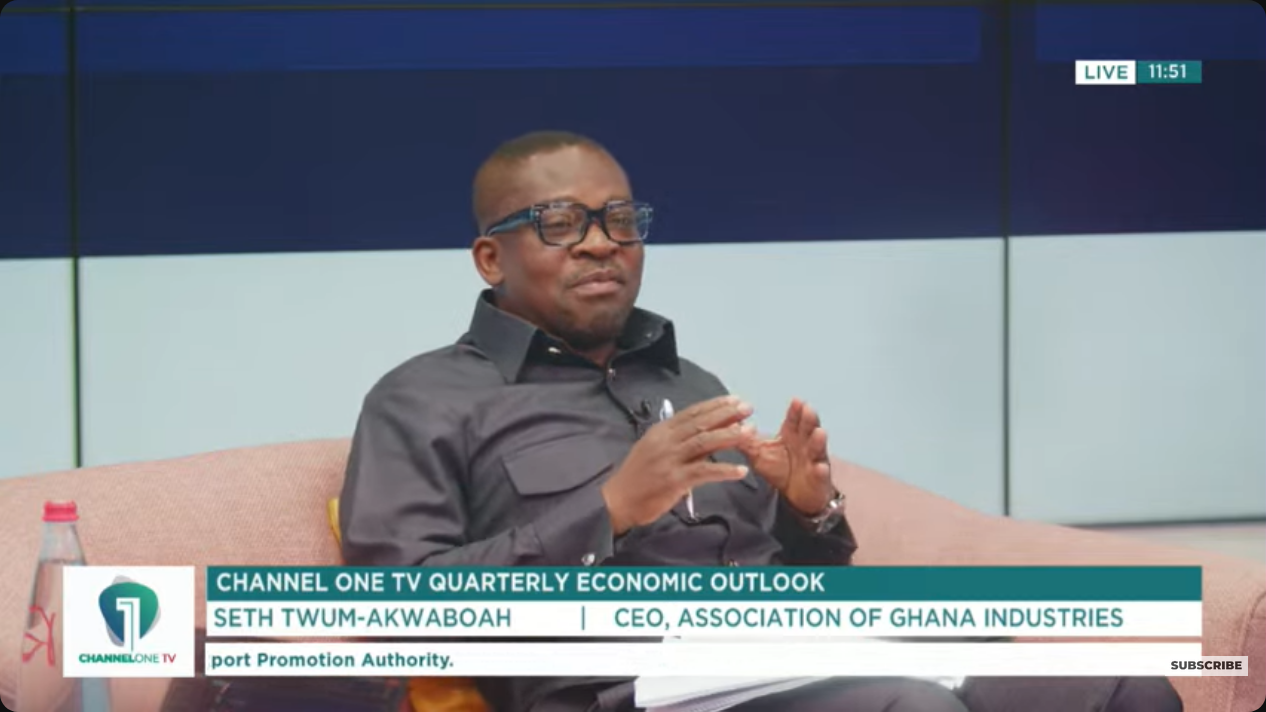
The Association of Ghana Industries (AGI) has raised concerns over a 48% increase in electricity costs faced by bulk industrial consumers following a change in their billing arrangement with the Electricity Company of Ghana (ECG), warning that the development could further weaken the competitiveness of Ghanaian manufacturers.
The Chief Executive Officer of the AGI, Seth Twum-Akwaboah, said electricity costs have remained the biggest challenge confronting businesses, with the latest increase adding further pressure to companies already dealing with high production costs.
Speaking on the Channel One TV Quarterly Economic Review on the mid-year performance of the Ghanaian economy on Thursday, July 9, 2026, Mr Twum-Akwaboah said the cost of electricity was a major factor businesses continue to monitor because it directly affects their ability to operate, expand and create jobs.
“For businesses, we are operating with cost. And if your cost is stable and is lowered, it means that if you get the same price levels, your revenue will be good. And if your revenue is good, you can expand, and you can continue to stay in business and employ people,” he said.
He said electricity costs had consistently ranked as the top concern in the AGI Business Barometer Report over the past two quarters, highlighting the impact of utility expenses on industrial operations.
“Cost of utility is very key. And if you look at the AGI Business Barometer Report, for the past two quarters, cost of electricity has come up as the number one challenge facing the businesses,” he said.
Mr Twum-Akwaboah explained that the recent increase affected bulk customers, which are companies that consume large amounts of electricity and previously benefited from special arrangements that allowed them to access power at relatively lower rates.
He said the arrangement was based on the economic principle that customers who consume larger volumes of a product typically pay lower unit costs.
“The bulk customers are high-energy-consuming companies. And they had an arrangement with ECG. The arrangement was that because you are bulk customers, remember that in economics, the basic principle is that the more of a product you consume or you buy, the cost per unit will reduce for you,” he said.
According to him, the arrangement was negotiated through the Energy Commission and enabled bulk consumers to purchase electricity at a lower cost. However, ECG later changed the status of these customers, resulting in a significant increase in their tariffs.
“Now suddenly, ECG changed the status. And within one month, the electricity tariffs went up by 48% for those who are bulk customers,” he said.
Mr Twum-Akwaboah said industries had been engaging stakeholders over the issue since the beginning of the year, stressing that electricity costs were among the factors businesses had little control over.
“There are factors you don’t have control over. Cost of electricity, you don’t have control. It is fixed by PURC. ECG will come after you if you don’t pay. So anytime it goes up, you are worried,” he said.
The AGI CEO warned that rising electricity costs could eventually translate into higher prices for locally produced goods as manufacturers pass on increased production expenses.
He said controlling production costs was critical because businesses that become too expensive would struggle to compete in both domestic and regional markets.
“When your pricing level is increasing, it means inflation is going up. And when local production costs go up, what it means is that we are becoming less competitive in the market,” he said.