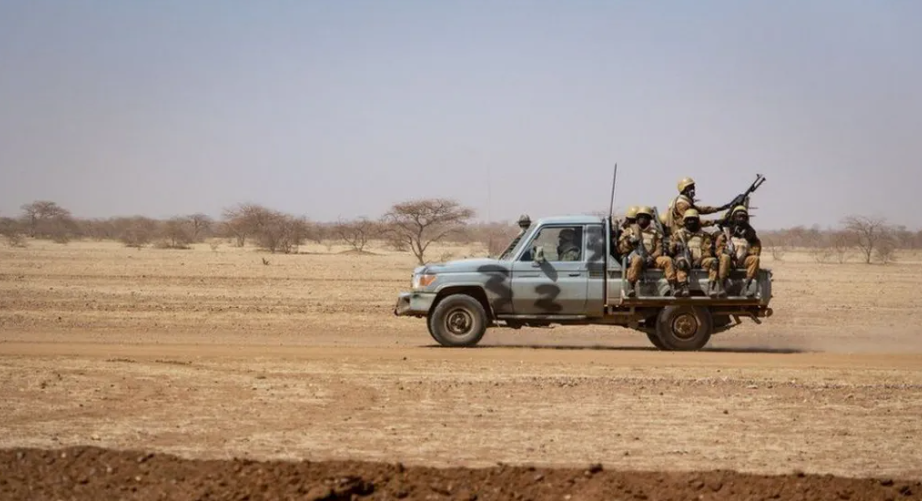
Three Ghanaians have told the BBC of their involvement in the fighting between Islamist insurgents and the military in neighbouring Burkina Faso, describing scenes of sometimes indiscriminate violence and bloody battles.
“We are always with the dead. In some battles, I’ve seen 40, 50 or 100 dead people,” one of the men told the BBC.
The three, all in their late thirties or early forties, said they had fought in Burkina Faso multiple times since 2018. They crossed the porous 550km-long (340-mile) border between the two countries, without being detected by the security forces.
They denied being primarily motivated by religion or being trained by the jihadists, saying they went to fight to defend civilian communities with whom they had strong family and ethnic ties.
“My elder brother, his wife and children were all killed by the [Burkinabe] army. It pains me a lot. The military came to their community in the forest. They killed all of them, a whole household, including 29 people,” one of the men said.
But another of the men did articulate religious zeal, saying: “If you die while fighting with the jihadists, then you are driving to jannah (an Islamic word for paradise), on the path of the righteous.”
Challenged over whether they had taken part in civilian attacks, the men were divided.
One denied doing so, but another conceded that he did.
“Some local people support the military in attacking us, that’s why we have to kill them too,” he said.
“You know… I’m not happy to fight like this. The number of people we kill, the people the military kill, it’s very bad. But this fight has entered our blood,” he added.
All three spoke on condition of anonymity.
The BBC was unable to confirm their claims but they showed us pictures of weapons, described the location of recent conflicts and named jihadist commanders in Burkina Faso.
The BBC was put in touch with the men through contacts at cattle markets in northern Ghana, where jihadist groups are alleged to be recruiting fighters.
In 2022, a France-based NGO, Promediation, said its research showed that the jihadists had recruited between 200 and 300 young Ghanaians.
And the Netherlands Institute of International Relations think-tank, in a report released last July, said the jihadists had “minimal success” recruiting in Ghana.
However, the men offered a different perspective, telling the BBC, in claims that could not be verified, that people from “all parts of Ghana” and from “many” ethnic groups were joining the insurgency in Burkina Faso.
“Some are fighting for jihad. Some are doing it for business,” one of them said.
The financial incentive comes in the form of the plentiful livestock that the jihadists steal from communities driven out of their villages.
“When we attack a community, we take their animals: sometimes 50, sometimes 100,” the BBC was told by one of the men.
The cattle are allegedly brought to northern Ghana, and sold at markets.
The trafficking across the border was confirmed to the BBC by cattle dealers.
It is thought to have become a major income stream for groups like Jama’at Nusrat ul-Islam wa al-Muslimin (JNIM), an al-Qaeda affiliate that is the most active jihadist group in Burkina Faso. It also operates in Niger and Mali.
The West African region was described by the UN last year as the epicentre of global jihadist violence.
Aid agencies say that over the last decade some two-million people have been displaced by the insurgency in Burkina Faso and tens of thousands killed.
Ninpoa Nasuri is one of the thousands who have fled to Ghana to escape the violence.
She told the BBC her husband was killed in front of her in 2024 during a raid on their village in eastern Burkina Faso by fighters from JNIM.
“They grabbed the men, and they beat them to death. My husband was a farmer. He had nothing to do with the government militia or the conflict,” she told the BBC.
Other refugees described similar acts of violence by the Burkinabe military.
“Some of the people they were killing were aged 80, aged 90. These people can’t hold a gun, can’t fight with anybody. They killed them for no reason,” Saafiya Karim said.
Ghana has so far remained largely untouched by the insurgency, although some attacks have taken place in neighbouring Togo and Ivory Coast.
In a recent statement to Ghanaian journalist Mohammed Eliasu Tanko, a man calling himself a representative of JNIM said the group had no interest in launching attacks in Ghana.
“They (JNIM fighters) are not allowed to take any action against Ghana. This is a clear and certain statement. JNIM do not seek war against Ghana,” the man, known as Ansari, said in the statement, which the BBC has seen.
However an upsurge in communal violence in one part of northern Ghana has raised concerns that the jihadists are trying to exploit the conflict to their advantage.
The town of Bawku is embroiled in a decades-long struggle between different ethnic groups for control of the local chieftaincy. More than 100 people are thought to have been killed in clashes since fighting intensified in last October.
“The evening in Bawku is always [one of] gunshots and fierce exchanges. People use AK47s, M16s, all kinds of automatic rifles,” a resident told the BBC.
JNIM smugglers are accused of selling weapons to both sides.
“We understand they are supplying weapons that they have taken from the military in Burkina Faso. They do this by relying on the trucks that travel up to Niger and back carrying onions. They hide the weapons inside those trucks,” Tanko told the BBC.
“One intelligence officer confirmed to me this was the new way they are bringing firearms in. And the Ghanaian security are ill-equipped to be able to detect these vehicles coming through, putting Ghana in a very critical situation,” he added.
Ghana’s Defence Minister Edward Omane Boamah did not respond to a BBC request for comment.
President John Mahama, who took office in January after winning December’s presidential election, visited Bawku last month in an effort to promote peace between the rival groups. However, gunfights continue to be reported.
Ghana’s governing party spokesman Sammy Gyamfi told the BBC that ending the violence in Bawku was the government’s “number one priority”.
“The violence is already spreading and if care is not taken it’s likely that insurgents from the wider region can take advantage of this conflict,” he said.
The three men the BBC spoke to said they did not rule out the possibility of the insurgency spreading.
“This thing can go to any place, or to any country. It didn’t exist in Togo but now the attacks are happening there. If they can go to Togo, they can get to Ghana. This thing is strong, it’s powerful,” one of them said.
But another of the men took a cynical perspective, saying the insurgents in Burkina Faso were no longer waging an “Islamic struggle”.
“They just kill the people, and steal their livestock. What is happening is not jihad and so I do not like it,” he said.
Explore the world of impactful news with CitiNewsroom on WhatsApp!
Click on the link to join the Citi Newsroom channel for curated, meaningful stories tailored just for YOU: https://whatsapp.com/channel/0029VaCYzPRAYlUPudDDe53x
No spam, just the stories that truly matter! #StayInformed #CitiNewsroom #CNRDigital