Ghana has been hailed globally for its political stability and economic growth in West Africa.
Since 1992, the country has experienced a smooth transition of power in line with its Constitution, providing the necessary environment for national development.
In line with the nation’s development agenda, governments have provided direction over the years on how the state plans to add value to livelihoods.
The write-up reflects on Ghana’s 2026 Budget in achieving transformation through prudent financial management.
The Public Expenditure and Financial Accountability (PEFA) defines Public Financial Management (PFM) as the set of laws, rules, systems, and processes a government uses to mobilise revenue, allocate funds, undertake spending, account for funds, and audit results.
Ghana’s Public Financial Management (PFM) Act, 2016 (Act 921) established a comprehensive legal framework for managing public finances, ensuring fiscal discipline, transparency, and accountability. In 2025, the Act was amended (PFM Amendment Act 1136) to introduce stricter fiscal rules, an independent Fiscal Council, and enhanced accountability mechanisms.
Ghana’s 2026 Budget, themed “Resetting for Growth, Jobs, and Economic Transformation,” marks a pivotal moment in the country’s economic journey. Building on years of Public Financial Management reforms, Ghana is leveraging a strengthened PFM framework as the backbone of its economic recovery and transformation agenda.
2.0 Why Public Financial Management Matters
The World Bank has it that sound public finance management is critical to the achievement of its goals of eradicating extreme poverty and promoting shared prosperity. PFM is critical to fiscal discipline and the efficient and effective use of scarce public resources to deliver public services.
Weaknesses in the management of public resources can have wide-ranging implications for development, including driving a wedge between public policy and its implementation.
In a business enterprise, effective management of finances aids the achievement of business objectives. Similarly, sound public financial management is critical to the achievement of the aims of the public sector through its role in improving the quality of public service outcomes; operational and strategic decision-making; long-term sustainability of public services; building public trust in the performance of the sector; and ensuring the efficient and effective use of public funds.
Optimal public financial management would additionally display flexibility that allows the targeted sectors to adjust easily and in the desired manner with the public sector-induced changes (ACCA UK). ACCA has identified four key objectives that effective public financial management should cover:
- Aggregate financial management – fiscal sustainability, resource mobilisation and allocation
- operational management – performance, value for money and strategic financial planning and management
- Governance – transparency and accountability
- Fiduciary risk management – controls, compliance and oversight
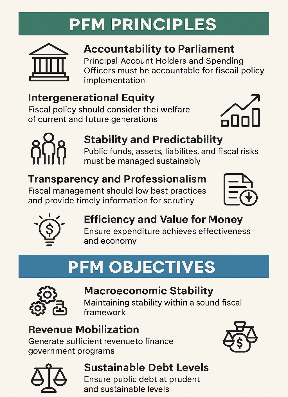
PFM is the cornerstone of fiscal governance in Ghana, established under the PFM Act, 2016 (Act 921) and strengthened by the 2025 amendment (Act 1136). Section 1 of the act provides a legal and institutional framework to ensure fiscal discipline, transparency, and accountability.
The Act mandates sound fiscal policy, prudent debt management, and value-for-money principles in public expenditure.
It emphasises sustainability, efficiency, and professional standards, requiring clear roles, timely reporting, and robust oversight by Parliament. By aligning revenue mobilisation, expenditure control, and risk management with macroeconomic stability, PFM safeguards public resources and builds trust in government financial operations.
3.0 PFM Reforms in the 2026 Budget
The Minister for Finance, in presenting the 2026 Budget to Parliament, stated that PFM reforms are central to Ghana’s economic reset agenda. The Minister emphasised that “fiscal discipline is the backbone of national progress” and reaffirmed the government’s commitment to transparency, accountability, and efficiency in managing public resources.
Building on the gains of 2025, the 2026 Budget introduces structural reforms to strengthen expenditure controls, prevent arrears accumulation, and enforce compliance with the PFM Act. Key initiatives include the review of procurement thresholds, the establishment of an independent Value for Money Office, operationalisation of sanctions for breaches under sections 96 to 98 of the PFM Act, which deals with offences, surcharges and penalties for contravention of the act, including jail terms, and deployment of digital tools for real-time monitoring.
These measures, according to the Minister, are designed to ensure that “every cedi delivers measurable value” and to restore public trust in fiscal governance. A Harvard Kennedy School working paper on PFM says globally, PFM reforms have become a defining feature of modern governance. Countries often implement them with technical and financial support from international organisations.
Over the past two decades, external assistance for PFM reforms has surged from about US$50 million in 1995 to nearly US$500 million by the late 2000s, a clear signal of their importance in driving sustainable development.
3.1. Fiscal Discipline and Debt Sustainability
The 2026 Budget marks a decisive continuation of Ghana’s fiscal consolidation agenda, anchored on discipline, transparency, and sustainability. Dr. Cassiel Ato Forson stated emphatically: “Fiscal discipline is the backbone of national progress. There is no shortcut to responsible economic management. Never again must we allow recklessness, waste and indiscipline to define how we handle the people’s money.”
The Minister highlighted that 2025 delivered one of Ghana’s strongest fiscal turnarounds in decades:
- The primary balance swung from a 3% deficit in 2024 to a 1.6% surplus by September 2025, exceeding targets and proving that discipline delivers results. The primary balance is the difference between government revenue and expenditure, excluding interest payments on public debt.
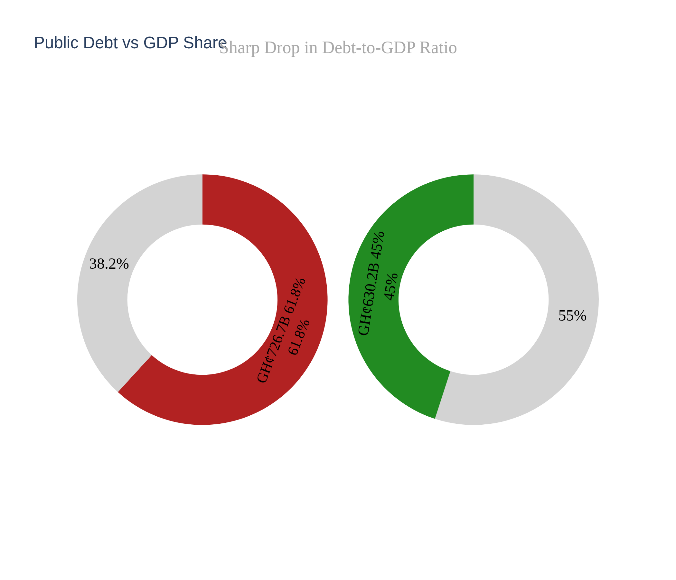
- Public debt dropped sharply from GH¢726.7 billion (61.8% of Gross Domestic Product (GDP) in 2024 to GH¢630.2 billion (45% of GDP) by October 2025—the steepest decline in Ghana’s history.
- For the first time in over a decade, Ghana recorded a negative rate of debt accumulation, moving from +19.1% in 2024 to –13.3% in 2025.
These gains, the minister said, were driven by reforms in revenue mobilisation, tighter expenditure controls, and liability management. He continues to say that treasury bill rates fell significantly, saving GH¢8.8 billion in interest payments, while investor confidence rebounded, reflected in Eurobond price recovery and credit rating upgrades by Fitch, Moody’s, and S&P. The Minister reaffirmed the government’s commitment to sustaining these gains:
- Primary surplus target: 1.5% of GDP on a commitment basis.
- Overall fiscal deficit: 2.2% of GDP (commitment basis), balancing consolidation with growth.
- Debt sustainability: Anchored on the Medium-Term Debt Strategy (MTDS), which prioritises reducing rollover risks, lowering interest costs, and deepening domestic markets.
He further noted, “Our fiscal stance balances consolidation with growth, maintaining discipline while safeguarding resources for productive investments under the Big Push Infrastructure Programme and other national priorities.” In respect of debt management reforms, the minister noted that 2026 introduces a new phase in debt management based on the below:
- Strategic re-entry into the domestic bond market after the expiration of the Domestic Debt Exchange restrictions in February 2026.
- Issuance of domestic infrastructure bonds to fund critical projects.
- Active buybacks and cash management operations to smooth the maturity profile and reduce costs.
3.2 Revenue Mobilisation and Tax Reforms
The 2026 Budget sets out an ambitious plan to deepen domestic resource mobilisation and modernise Ghana’s tax system to make it fairer, simpler, and more efficient.
As Dr Cassiel Ato Forson emphasised, emphasised: “government will deepen domestic resource mobilisation through the implementation of the Medium-Term Revenue Strategy and undertake comprehensive VAT reforms.” Revenue targets detailed in the budget statement include:
- Total revenue and grants for 2026 are projected at GH¢268.1 billion, an increase of 18.3% from GH¢226.7 billion in 2025.
- Non-oil tax revenue remains the backbone, expected to reach GH¢216.1 billion, driven by improved compliance and enforcement.
- Oil and gas receipts will contribute GH¢13.6 billion, while non-tax revenue is projected at GH¢20.9 billion, with GH¢18.2 billion retained by MDAs.

The Minister also announced a landmark Value Added Tax (VAT) reform package designed to remove distortions, reduce cascading effects, and ease compliance, which is detailed below:
- Abolition of the COVID-19 Health Recovery Levy, which put GH¢3.7 billion back into the pockets of individuals and businesses in 2026.
- Integration of the Ghana Education Trust (GET) Fund and National Health Insurance Levy into the VAT base, which allows input tax deductions and reduces business costs by 5%.
- Reduction of the effective VAT rate from 21.9% to 20%.
- Increase in VAT registration threshold from GH¢200,000 to GH¢750,000, easing the burden on small businesses.
- Extension of VAT zero-rating on locally manufactured textiles to 2028, protecting over 2,000 direct jobs.
3.3 Expenditure Control and Value for Money
The Budget underscores the government’s commitment to prudent spending and efficiency in public financial management. As the Minister for Finance stated: “Every cedi saved will be redirected to projects that create jobs and deliver tangible benefits to Ghanaians.”
To achieve fiscal sustainability and prevent waste, the Budget introduces strong expenditure controls noted below:
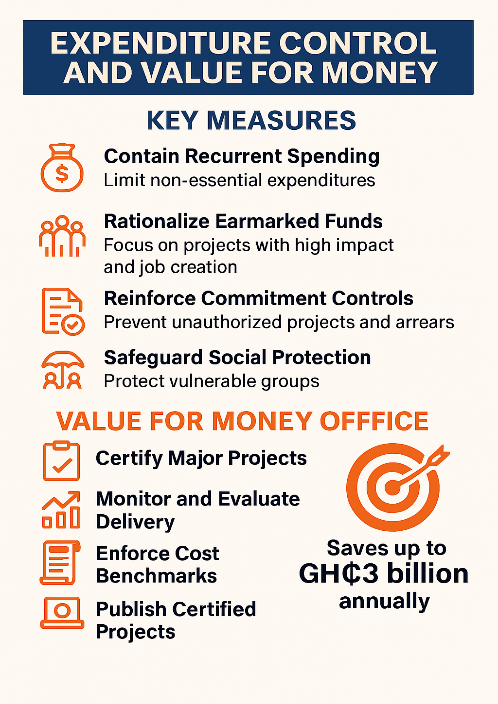
- Contain recurrent spending by capping non-essential expenditures such as foreign travel, workshops, and vehicle procurements.
- Rationalise earmarked funds toward high-impact, job-creating projects in roads, energy, agriculture, and education.
- Reinforce commitment authorisation processes, ensuring no new projects are initiated without budgetary approval or funding—critical to preventing arrears accumulation.
- Safeguard social protection allocations for Livelihood Empowerment Against Poverty (LEAP), National Health Insurance Scheme (NHIS), School Feeding, and Free Secondary Education to protect vulnerable groups.
The Minister announced operational reforms to strengthen expenditure discipline by:
- Enforcing sanctions under Sections 96 to 98 of the PFM Act for breaches related to arrears accumulation and non-compliance with commitment controls.
- Sustaining payroll validation exercises to eliminate ghost names and ensure only legitimate employees remain on the public payroll.
- Comprehensive review and audit of budget preparation and implementation processes to streamline workflows and enhance transparency.
- Implementing recommendations from the arrears and commitments audit, conducted with the Auditor-General and international audit firms, to prevent future liabilities.
- Institutionalising quarterly expenditure reviews and real-time audit monitoring to curb overspending and improve efficiency.
A major innovation in the Budget is the creation of an independent Value for Money Office (VfMO), described by the Minister as “Ghana’s watchdog for prudent spending and real results”.
The VfMO will play a pivotal role in ensuring fiscal integrity and efficiency. It will certify major projects before approval and monitor delivery to guarantee that every cedi spent achieves measurable value.
The office will enforce cost benchmarks and require public VfM certificates for all contracts, while coordinating closely with the Auditor-General, the Public Procurement Authority, and the Internal Audit Agency to impose penalties for waste and fraud.
Additionally, the VfMO is said to launch a Transparency Portal to publish certified projects and enable real-time citizen feedback.
This reform, the minister said, is projected to save up to GH¢3 billion annually, reduce contract inflation, and restore public trust in government spending.
3.4. Audit and Arrears Management
Upon assuming office, the minister said the government faced a daunting fiscal risk with outstanding arrears and payables totalling GH¢68.8 billion, made up of GH¢50.5 billion in unpaid invoices and interim payment certificates (IPCs) and GH¢18.3 billion in outstanding Bank Transfer Advice (BTAs).
To safeguard the public purse and ensure value for money, a special audit was commissioned, led by the Auditor-General in collaboration with PwC and EY.
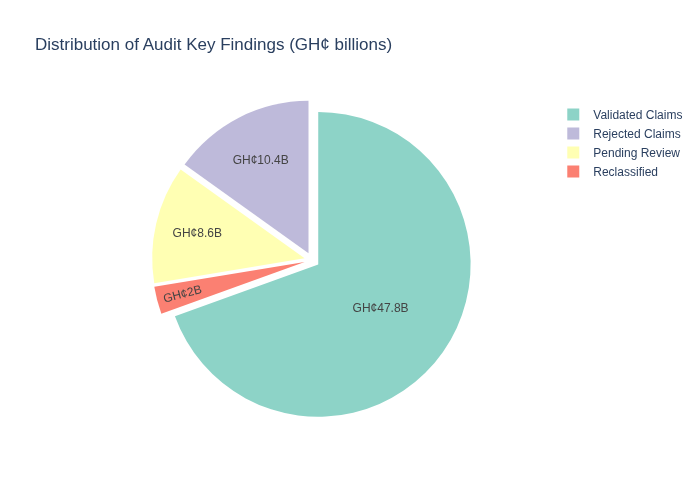
The special audit commissioned by the government to validate outstanding arrears and commitments has yielded significant results. Out of the total GH¢68.8 billion submitted for review:
- GH¢47.8 billion was confirmed as legitimate claims.
- GH¢8.6 billion remains under review, pending additional documentation and third-party confirmations.
- GH¢10.4 billion was disallowed due to various degrees of irregularities.
It was also observed that GH¢1 billion of the rejected BTAs had already been approved for payment, underscoring the critical role of audit in preventing financial losses.
Further to this, the minister said in the budget statement that GH¢2 billion was reclassified from claims and BTAs to commitments.
4.0 Impact on Governance and Service Delivery
The Budget demonstrates a strong commitment to improving governance and service delivery through fiscal discipline, transparency, and structural reforms. The government has reinforced expenditure controls by institutionalising quarterly reviews and real-time audit monitoring.
Sanctions under Sections 96 to 98 of the PFM Act will now apply to breaches related to arrears accumulation and commitment controls, while the revised Fiscal Responsibility Act strengthens compliance across MDAs, signalling a zero-tolerance approach to fiscal indiscipline.
The establishment of the VfMO introduces a new layer of oversight to curb waste and ensure efficiency. By certifying major projects before approval and enforcing cost benchmarks, VfMO will strengthen project delivery and rebuild public trust.
Updated procurement thresholds under the Public Procurement Act will further streamline processes, enabling faster execution of community-level projects.
The minister indicated that the government’s budget statement is going to implement technology-driven reforms, including AI-powered trade analytics and digital VAT administration, which will enhance revenue mobilisation and reduce leakages.
The rebasing of GDP and CPI by the Ghana Statistical Service is expected to improve data accuracy, enabling evidence-based policy decisions and smarter resource allocation.
As the Minister noted, “Effective governance begins with evidence. What we cannot measure, we cannot manage.”
5.0 Challenges and Opportunities
The 2026 Budget reflects Ghana’s determination to consolidate fiscal gains while addressing structural weaknesses that have historically undermined public financial management. However, the path to transformation is not without challenges.
The legacy of arrears remains a significant fiscal risk. Despite the special audit that validated GH¢47.8 billion and rejected GH¢10.4 billion in irregular claims, GH¢8.6 billion still awaits verification, creating uncertainty for expenditure planning and cash management.
The Minister described these findings as “troubling and damning” in the budget statement, underscoring the need for stronger commitment controls and real-time monitoring to prevent recurrence. Revenue mobilisation faces persistent vulnerabilities. While the Medium-Term Revenue Strategy and VAT reforms aim to broaden the tax base, enforcement remains very critical.
Leakages at the ports, under-invoicing, and abuse of Import Declaration Forms, linked to US$31 billion in transfers without imports, highlight systemic weaknesses that could erode fiscal space if not decisively addressed. Expenditure pressures from social interventions and infrastructure commitments pose sustainability risks.
Allocations such as GH¢30 billion for the Big Push Infrastructure Programme and GH¢33.3 billion for education reforms are transformative but demand strict adherence to value-for-money principles to avoid cost overruns and inefficiencies.
On the upside, the 2026 Budget introduces bold governance reforms that can redefine PFM. The establishment of the VfMO offers a structural solution to inefficiencies by certifying projects before approval and enforcing cost benchmarks. As the Minister assured, “This reform will save up to GH¢3 billion a year, cut contract inflation, and rebuild public trust.” Digitalisation presents another opportunity.
AI-powered trade analytics, digital VAT administration, and rebasing of GDP and CPI will strengthen evidence-based policymaking and enhance revenue assurance. These initiatives align with the Minister’s assertion that “Effective governance begins with evidence. What we cannot measure, we cannot manage.”
Furthermore, targeted investments in education, health, and social protection create a platform for inclusive growth. Ending the double-track system, expanding healthcare infrastructure, and scaling social safety nets demonstrate how fiscal stability can translate into improved service delivery and human capital development.
6.0 Conclusion
The Budget statement represents more than a fiscal plan; it is a blueprint for rebuilding trust in public financial management and driving inclusive transformation. In less than a year, Ghana is moving from crisis to stability, anchored on reforms that prioritise fiscal discipline, transparency, and accountability.
Key achievements underscore this turnaround; thus, GDP growth accelerated to 6.3% in the first half of 2025, inflation fell sharply from 23.8% to 8%, the first single-digit rate in four years, and the cedi appreciated by nearly 35% against the US dollar, ranking among the best-performing currencies globally.
International reserves climbed to $11.4 billion, covering almost five months of imports, while fiscal discipline was restored with a primary surplus of 1.6% of GDP. Public debt declined from 61.8% of GDP in December 2024 to 45% by October 2025, and borrowing costs dropped dramatically as Treasury bill rates fell from over 30% to around 10%.
These gains were anchored on deep structural reforms: amendments to the PFM Act introduced a fiscal rule mandating a minimum primary surplus and a long-term debt ceiling; an Independent Fiscal Council was also established to enforce transparency and accountability; as well as commitment controls were strengthened to prevent arrears accumulation.
The IMF-supported programme provided a strong policy anchor, reinforcing credibility while allowing Ghana to pursue homegrown reforms aligned with national priorities.
Yet, challenges still exist. Fiscal risks from legacy arrears, revenue leakages, and sectoral vulnerabilities require sustained vigilance. The 2026 Budget is set to respond with measures to consolidate stability, digitalisation of revenue systems, establishment of the Value for Money Office, and targeted investments in education, health, and infrastructure to ensure that fiscal prudence translates into inclusive growth.
Ultimately, the 2026 Budget is “more than numbers”, as the minister said, it is a blueprint for resilience and shared prosperity. It demonstrates that disciplined PFM is not an end in itself, but rather a means to restore confidence, create jobs, and improve lives.
About the writer, David Aidoo, FCCA, CITG, BIDA, FMVA.
David Aidoo is a seasoned finance and grants management professional with over a decade of progressive experience spanning the public, private, and development sectors. He has expertise in Programme and Project Management Delivery; Finance and Grant management; Strategy Development and Implementation, Business Process Optimisation, as well as Data Management.
He holds an MBA in Finance, is a Fellow of the Association of Chartered Certified Accountants (ACCA UK), a Chartered Tax Accountant (CIT GH), a Certified Business Intelligence & Data Analyst (BIDA), as well as a Certified Financial Modelling & Valuation Analyst (FMVA). David also has certification in Public Financial Management, Project Management, and Grants Management.
David currently works for The Global Fund as a Specialist, Grant Financial Management in Geneva. Before joining The Fund, he was a Senior Manager at Deloitte Africa, consulting on diverse portfolios including Public Financial Management.