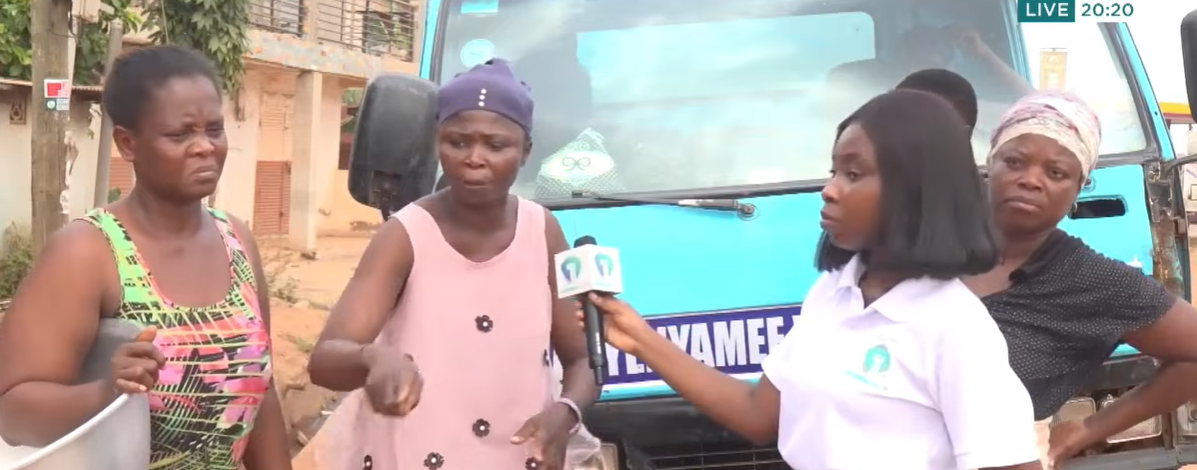
Residents of Kakasunanka, Gbetsile, Okushibri, Appolonia and Newland in the Kpone–Katamanso Municipality are raising alarm over a prolonged water shortage that has left homes and businesses struggling to cope.
For more than five months, taps in these communities have remained dry, forcing households to rely on alternative and often costly sources of water. The situation, residents say, has disrupted daily life and placed an additional financial burden on already strained families.
Many residents trace the beginning of the crisis to shortly after the Muslim festival of Eid.
“Since the Muslim community celebrated Salah, we have not had a drop of water. We sometimes fetch water from a nearby block factory, but even that is not reliable,” a resident, Maame Susan, told Channel One News.
The shortage is also affecting children, particularly with schools now in session. Parents say securing water in the early hours of the day has become a necessity.
“The children have resumed school, so if you don’t wake up very early, you won’t get water for them to prepare and go to school,” another resident, Paa Gideon, explained.
With no supply from Ghana Water Limited, many households have turned to private water tanker services. However, the cost is proving unsustainable. Residents say a single tanker delivery can cost significantly more than what they would typically pay for a month’s piped water supply.
“We are always buying water, and one gallon costs five cedis. How do we even make money to survive under these conditions?” a frustrated resident questioned.
Water vendors themselves admit the situation is becoming increasingly difficult.
Some say they struggle to find reliable sources to supply their customers and have resorted to boreholes to meet demand.
Beyond the cost, concerns are mounting over the quality and safety of the water being consumed. Residents say they have little assurance about the sources of the water, even as they use it for cooking, bathing and drinking.
Adding to their frustration is the issue of billing. Despite the lack of water supply, many households report receiving monthly bills from Ghana Water Limited—often based on estimated usage.
“Water is not flowing, yet we are still being billed,” one resident said.
“They keep moving around to read meters and issue bills, but there is no water in the pipes. What exactly are we paying for?” another asked.
In response, the Communications Department of Ghana Water Limited says efforts are underway to resolve the situation and restore supply to the affected communities. The company has also apologised for the inconvenience caused.
However, residents say apologies are not enough. They are demanding clear communication on the cause of the disruption, a definite timeline for restoration, fair billing practices that reflect actual consumption, and long-term investment in water infrastructure to prevent future occurrences.
For now, families in Kpone–Katamanso continue to navigate daily life without a reliable water supply, paying more for less, and waiting for solutions that cannot come soon enough.