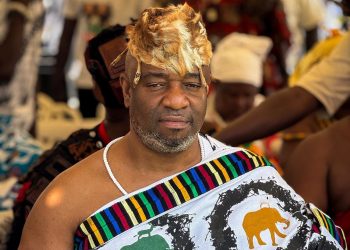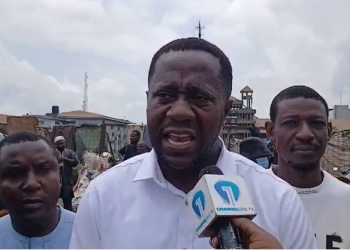
The Ashanti Regional Chairman of the New Patriotic Party (NPP) Bernard Antwi Boasiako, popularly known as Chairman Wontumi, has vehemently denied authorising prosecution witness Henry Okum (PW2) to mine on Akonta Mining’s concession.
He insisted the arrangement between them was strictly for land reclamation and coconut planting.
Testifying in his own defence on Thursday, May 21, at the High Court in Accra, Wontumi said PW2 was only permitted onto the concession to reclaim degraded portions of the land by planting coconut trees, denying allegations that he assigned mineral rights or knowingly facilitated illegal mining activities.
Wontumi, who is standing trial together with Akonta Mining on charges including assigning mineral rights without ministerial approval, opened his defence after the prosecution closed its case.
Before his testimony, the defence had called two witnesses — mining expert Wisdom Gomashie and former Deputy Lands Minister George Mireku Duker.
Under cross-examination by Deputy Attorney General Dr Justice Srem Sai, Wontumi admitted that he allowed PW2 access to the concession but maintained that the purpose was reclamation, not mining.
“I didn’t give him permission to mine,” he told the court.
“He came to reclaim the land and plant coconut trees so that when the coconuts mature, we would share.”
He further testified that he never assisted PW2 to acquire excavators or other earth-moving equipment, contrary to the prosecution’s claims.
“That is not true. I do not know what work he did. He only planted trees and carried out reclamation. I did not assist him in purchasing any earth-moving equipment,” he said.
The prosecution, however, maintained that Wontumi knowingly permitted mining activities on the concession and deliberately distanced himself physically from the site to avoid direct association with the operations.
Justice Srem Sai put it to Wontumi that he knew PW2 was a small-scale miner and allowed him onto the concession for mining purposes.
But Wontumi rejected the assertion, insisting PW2 introduced himself as a “service support miner” and not someone seeking to mine illegally.
The prosecution also suggested that Wontumi’s business model involved acquiring mining leases and allowing others to engage in illegal mining in exchange for a share of the proceeds, often referred to as “goodwill” or “percentage” within illegal mining circles.
Wontumi denied the allegation as a “blatant falsehood.”
Central to the prosecution’s case is the testimony of PW2, Henry Okum, who previously told the court that Wontumi agreed he could mine portions of the concession while using proceeds from the mining to finance reclamation works.
In an earlier ruling directing Wontumi to open his defence, Justice Audrey Kocuvie-Tay cited portions of PW2’s evidence and Wontumi’s own caution statement to the police.
“The evidence on record shows that A1 did permit PW2 to enter the concession,” the judge held.
The ruling referenced Wontumi’s caution statement in which he admitted allowing PW2 onto the concession “only to plant coconut trees to reclaim the mined portion of the concession.”
However, the judge also highlighted aspects of PW2’s testimony which the court considered significant in determining whether a prima facie case had been established.
According to the ruling, PW2 stated that: “A1 agreed that I mine on the unmined portions of the concession… A1 did not give me any money to do the reclamation works as I was expected to use a portion of the proceeds from my mining activities… to defray the cost of reclamation.”
Justice Kocuvie-Tay said the absence of direct funding for reclamation strengthened PW2’s account.
“Essential to the believability of PW2’s testimony is the fact that A1 did not give PW2 funds for the reclamation exercise, which A1 admits to allowing PW2 to undertake on his concession. How else did A1 expect PW2 to fund the reclamation exercise?” the judge stated in the ruling.
During Thursday’s proceedings, however, Wontumi acknowledged that he had no written agreement with PW2 documenting the reclamation arrangement.
“I have no documentation with PW2 apart from the instruction to reclaim the land and plant trees, which he has done, and when it matures, we will share,” he told the court.
He also admitted he never visited the site after allowing PW2 onto the concession, though he claimed PW2 sent him videos showing reclamation works and the planting of about 18,000 coconut trees.