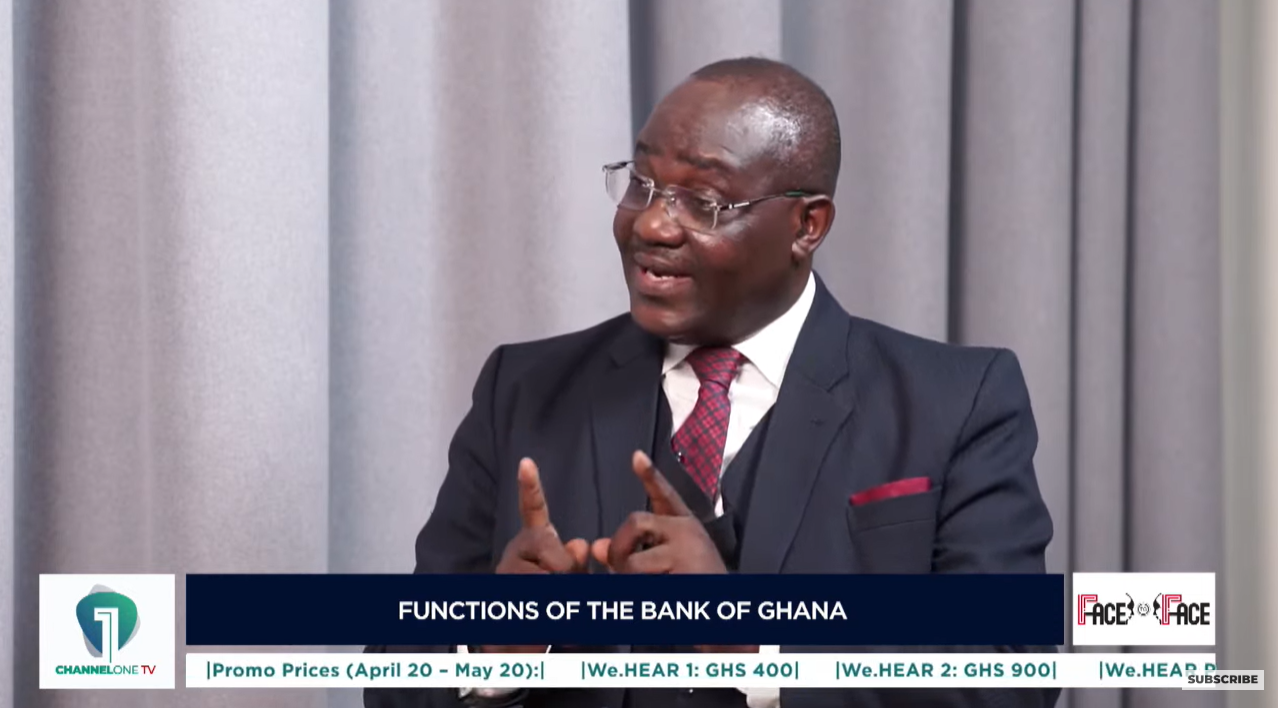
The Bank of Ghana has reaffirmed that its primary mandate is to maintain price stability, underscoring the distinction between the role of the central bank and that of commercial banks.
Director of Communications at the Bank of Ghana, Bernard Otabil, made this known in an interview on Channel One TV’s Face to Face on Tuesday, May 5, where he outlined the institution’s core functions within Ghana’s financial system.
He explained that while commercial banks focus on deposit-taking, savings and lending activities, the central bank operates under a fundamentally different legal and policy framework.
“At the Bank of Ghana, our job is quite different. We are not the same as a commercial bank,” he said, adding that the institution’s mandate is clearly defined under Section 3 of the Bank of Ghana Act.
Otabil stressed that maintaining price stability remains the central bank’s overriding objective.
This comes on the back of the growing public and political debate over the central bank’s financial performance after the GH¢15.6 billion loss disclosed in its 2025 financial statement.
Beyond this, he said the Bank of Ghana plays a broader role in supporting economic development, safeguarding financial system stability, regulating and supervising banks, and ensuring the efficiency of the national payment system.
According to him, a well-functioning payment system is essential for the effective transmission of monetary policy, noting that disruptions could weaken the impact of decisions such as interest rate adjustments.
He added that the central bank oversees critical financial infrastructure, including settlement systems and digital payment platforms, to ensure seamless financial transactions across the country.
On regulation, Otabil said the Bank of Ghana supervises commercial banks to ensure they remain financially sound and adequately capitalised to perform their intermediary role in the economy.
He also clarified the concept of fractional banking, explaining that banks are required to hold a portion of customer deposits as reserves with the central bank to maintain liquidity and stability.
“The money sits with us… it is part of ensuring that the banking system remains solid and can meet obligations,” he explained.
Otabil further noted that banks must meet minimum capital requirements, which serve as a buffer to strengthen their operations and protect depositors.
Touching on currency issuance, he said the Bank of Ghana is responsible for printing and circulating money based on prevailing economic conditions rather than arbitrary decisions.
He explained that currency issuance is driven by factors such as seasonal demand, government expenditure and broader market activity, with systems in place to ensure adequate cash supply.
According to him, the central bank continuously monitors liquidity conditions to ensure sufficient money is available in the economy to support transactions and growth.
Read also