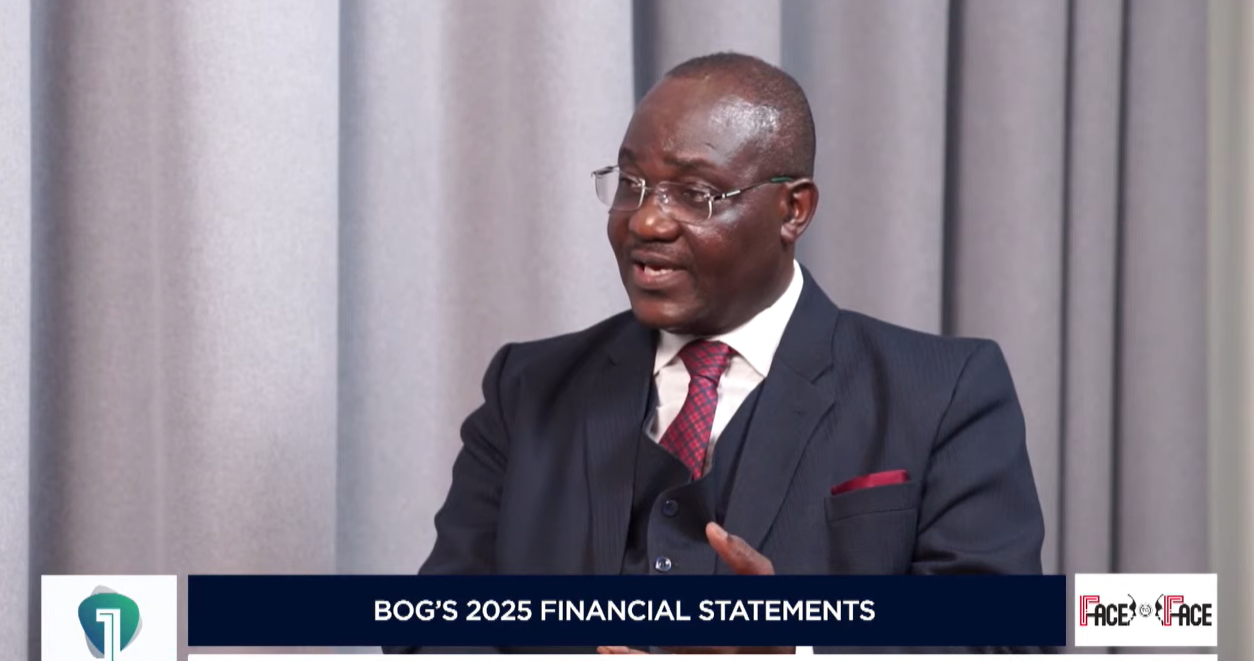
The Bank of Ghana (BoG) has defended its financial position following heightened scrutiny over its 2025 accounts, insisting that the institution remains fully capable of carrying out its core mandate despite recording a significant loss.
Speaking on Channel One TV’s Face to Face on Tuesday, May 5, the Head of Communications at the Bank of Ghana (BoG), Bernard Otabil, said the central bank is “policy solvent” and not at risk of operational disruption.
His comments come in the wake of growing public and political debate after the central bank reported a GH¢15.6 billion loss in its 2025 financial statement.
Otabil stressed that the financial outcome should be understood within the framework of central banking operations, where the ability to implement policy effectively takes precedence over profitability.
“We are policy solvent, and I always keep saying that if in doubt, you always have to look at the cash flow position; the account that presented came with other supporting accounts as well. And these are all laid down bare in the books. So if you are looking at whether the Central Bank is able to continue its business as usual and that no significant part of its operations will be curtailed in the next foreseeable future…we are clearly in the clear. And even if you look at what has been put there, the policy solvency figure of about 5.5 or so, it gives you that strong sense that this is what is happening in the Central bank,” he said.
He explained that “policy solvency” reflects the Bank’s capacity to fund and sustain its monetary policy operations, particularly in maintaining price stability and managing liquidity in the economy.
According to him, an assessment of the Bank’s cash flow position and supporting financial statements shows that it remains financially functional and operationally sound.
The Bank of Ghana’s 2025 accounts have triggered debate among analysts and policymakers, with concerns raised about the scale of losses and the institution’s negative equity position.
However, Otabil maintained that such figures must be interpreted in the proper context of central banking, where balance sheet outcomes often reflect the cost of stabilising the economy during periods of financial stress.
He emphasised that the central bank’s ability to continue its operations without constraint remains intact, dismissing suggestions that its financial position could undermine its mandate.
The clarification forms part of ongoing efforts by the Bank of Ghana to address public concerns and explain the implications of its recent financial performance.