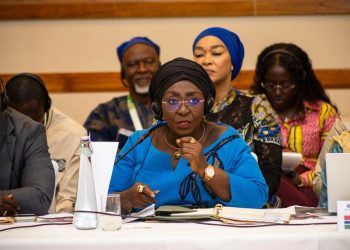
Dr Eunice Brookman-Amissah, a Member of the Council of State, has called for sexual and reproductive health and rights (SRHR) to be prioritised within national health systems to ensure that policies are guided by public health evidence and human rights rather than ideology or folklore.
She stressed the need for measures to integrate healthcare services through data-driven systems, including neglected groups such as youth, into policy frameworks, and to mobilise human and financial resources to address gaps in the implementation of SRHR initiatives.
Dr Brookman-Amissah made the call during the 10th JEAM Leadership Lecture Series held in Ho, Volta Region, in honour of the late former President, John Evans Atta Mills, who established the University of Health and Allied Sciences (UHAS).
The lecture was held on the theme: “From Knowledge to Action: Bridging Africa’s Reproductive Health Gap – The Role of Health Training Institutions.”
She urged stakeholders to familiarise themselves with international, regional and national policy frameworks, integrate them into educational curricula, and support the implementation of existing policies through standards, protocols and guidelines.

Dr Brookman-Amissah, a former Ambassador to the Netherlands, also called for increased investment in primary healthcare workers, particularly nurses, midwives and mid-level providers, to strengthen task-sharing and bring healthcare services closer to communities.
She further advocated establishing one-stop centres to improve data collection and utilisation, while strengthening logistics systems within the health sector.
According to her, although maternal mortality rates are declining due to improvements in healthcare and reproductive services, progress remains slow in Africa, where stronger commitments and investments are still required.
On Comprehensive Sexuality Education (CSE), she explained that the programme was intended to provide scientific, accurate and age-appropriate information to young people, but noted that many parents and teachers lacked the capacity to effectively guide and counsel the youth.
Citing data from the World Health Organisation (WHO), she said more than 40 million abortions occur globally each year, with 22 million classified as unsafe. Africa alone records about 6.2 million cases, representing 28 per cent of the global figure.
She added that unsafe abortions account for about 30 per cent of maternal deaths, with approximately 1.8 million hospitalisations recorded annually in Africa, placing significant economic and health burdens on women and families.
Dr Brookman-Amissah emphasised that although abortion is legal in Ghana under specific conditions, many people remain unaware and wrongly assume all forms of abortion are illegal.
She explained that Ghana’s abortion law, amended in 1985 under Article 29, Section 58 of the Criminal Code 1960, permits abortion in cases such as rape, incest, and threats to the physical or mental health of the mother, provided the procedure is carried out by a registered medical practitioner in an approved facility.
“It is about the health and rights of all people, especially the poor and the young. We need knowledge and information to improve the sexual and reproductive health and lives of men, women and young people in Ghana and across Africa,” she said.
She called for intensified efforts to reduce unsafe abortions and urged the government to prioritise national resources for reproductive health services to save lives.
Reflecting on the legacy of the late President Mills, Dr Brookman-Amissah described him as a humble, hardworking and dedicated servant of the nation, recalling their early association at Achimota School.
Lydia Aziato, Vice-Chancellor of UHAS, said the university continued to uphold the vision of its founder and was growing in relevance and impact while setting national and international standards.
She noted that the institution’s values and ethical framework aligned with the ideals of Professor Mills, whom she described as an accomplished academic, statesman and leader.
Prof Aziato reaffirmed UHAS’s commitment to becoming a leading health research institution dedicated to community service through innovation in research, teaching and societal engagement.
Dignitaries present at the event included Kodzo Gavua, Chairman of the Governing Council of UHAS; Frank Edwin, Pro-Vice Chancellor; Fred Newton Binka, Founding Vice-Chancellor; John Gyapong, immediate past Vice-Chancellor of UHAS; and George Kofi Nfodjo, Ghana’s Ambassador to Togo, as well as faculty, lecturers and students.

Meanwhile, the Governing Council and Management of UHAS conferred an honorary doctorate on Dr Brookman-Amissah in recognition of her resilience, commitment and contributions to Ghana’s health sector and beyond.