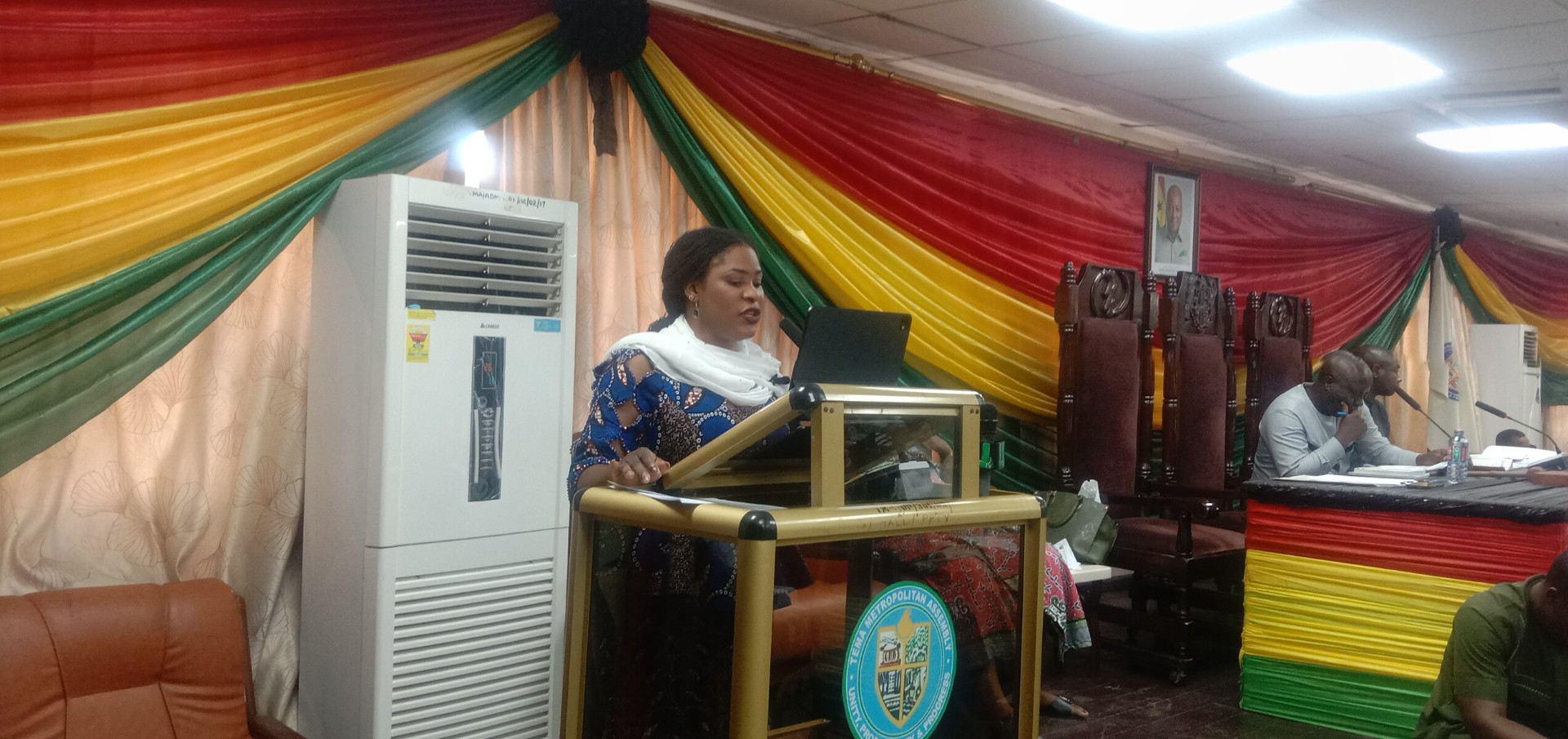
The Tema Metropolitan Assembly (TMA) has called for a more structured and clearly defined partnership with the Ghana Ports and Harbours Authority (GPHA) to address the growing pressure port-related activities place on Tema’s infrastructure and urban development.
Tema Metropolitan Chief Executive, Ebi Bright, made the call after GPHA officials were invited to the Assembly’s general meeting to respond to concerns over the deteriorating condition of key access roads to the port, particularly the Harbour Road and Meridian Road.
She said cooperation between the Assembly and GPHA must go beyond goodwill and be anchored on clearly defined responsibilities that safeguard the interests of the city and its residents.
Ms Bright made the remarks during the first ordinary session of the Assembly, noting that Tema continues to carry a significant social and infrastructural burden as a result of the country’s expanding port operations, while the Assembly has limited input in key decisions affecting the city’s development trajectory.
She explained that existing legal frameworks give the Assembly authority over planning and development within its jurisdiction, stressing the need for all institutions operating in the metropolis to align with Tema’s broader development agenda.
While acknowledging GPHA’s operational autonomy within the port enclave, she said decisions taken within the port often have direct consequences for surrounding communities, particularly in areas such as transport infrastructure, environmental management and public services.
She cited the increasing volume of heavy-duty trucks in the city as a major concern, disclosing that about 5,000 trucks pass through Tema daily, placing significant strain on roads and other public infrastructure.
According to her, the city receives limited direct financial benefit from hosting the country’s busiest port, noting that revenues generated by GPHA are channelled to the central government, while the TMA does not receive a dedicated share to offset the infrastructural burden.
Ms Bright therefore called for what she described as a “revolution” in the working relationship between the Assembly and GPHA, aimed at ensuring fairness, accountability and improved coordination in urban planning and development. She also raised concerns about the relevance of Tema’s existing master plan, stating that many aspects of the original layout no longer reflect current realities.
She expressed optimism that sustained dialogue between the Assembly and national institutions operating within the metropolis would lead to clearer responsibilities and more effective collaboration in addressing the city’s growing urban challenges.
Meanwhile, Engineering Manager at GPHA, Kwamla Ofori, clarified that road construction and maintenance do not fall within the authority’s core mandate, although it continues to support such interventions as part of its corporate social responsibility.
He said GPHA has contributed to road rehabilitation projects in several parts of the country, including the Western Region, and is currently considering the reconstruction of the Tema Harbour Road despite it not being part of its formal responsibilities.
Mr Ofori added that the authority has also undertaken pothole patching works but said sustained road maintenance remains challenging as its primary mandate is port operations.
On truck congestion, he acknowledged that heavy-duty vehicle traffic in Tema remains a major challenge, noting that while GPHA provides designated truck parking facilities within its operational area, behaviour outside the port remains beyond its control.
He disclosed that GPHA has acquired land near the Tema Oil Refinery for the development of a truck park, with plans to pave and improve the facility to ease congestion. He added that earlier efforts to establish additional truck parks around Ashaiman were unsuccessful due to limited stakeholder cooperation.
Mr Ofori further called for stricter enforcement of truck parking regulations, including the imposition of heavy fines on offenders, to encourage compliance and reduce disruption to residents and road users in the metropolis.
Source: GNA