In Ghana’s cocoa landscapes where livelihoods, global markets, and future generations are deeply interconnected; the fight against child labour is entering a new, more coordinated phase.
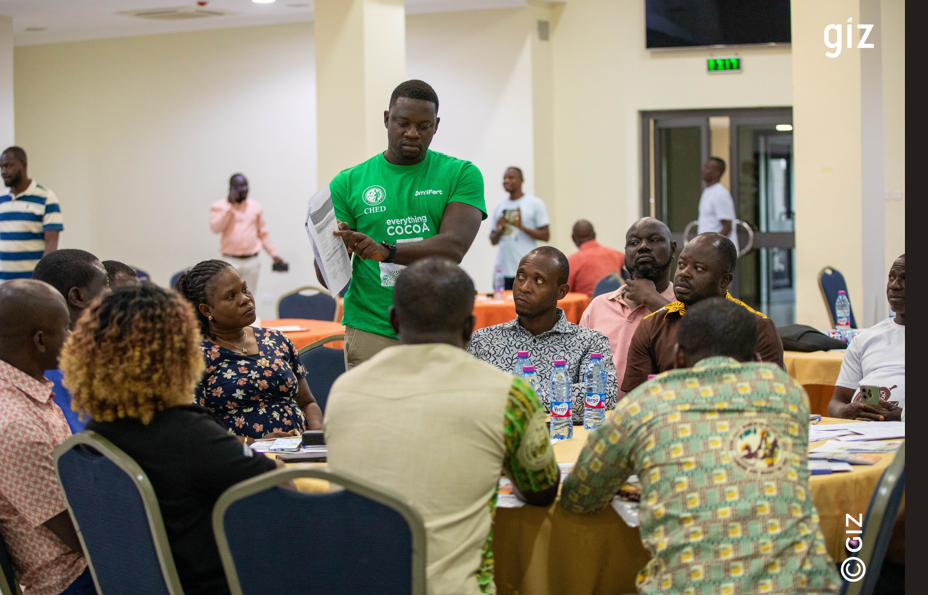
Strengthening the fight against child labour in Ghana’s cocoa sector took a major step forward. Two separate Training of Trainers (ToT) workshops on COCOBOD´s Child Labour Manual were organized by the GIZ-Sustainable Cocoa Programme. Each of the training sessions spanned four days.
The first training was held in Koforidua, the Eastern Regional capital and the second in Kumasi, Ashanti region. The two trainings were attended by 9 Regional Extension Officers and 70 District Extension Coordinators of the Cocoa Health and Extension Division (CHED) across all cocoa-growing regions The objective of the workshop was to strengthen their capacity to deliver step-down training to Cocoa Extension Agents (CEAs), who will, in turn, use the manual to educate farmers as part of ongoing efforts to eliminate child labour in the cocoa sector.
Akosua Daah Agyente, Head of the Child Labor Desk at COCOBOD, expressed appreciation to GIZ for their unwavering support in the development of the training manual on Child Labour and also organizing the ToT workshop.

The sessions are part of preparations towards the country-wide roll-out of the Cocoa Sector-Child Labour Monitoring System (CS-CLMS), which is being piloted in the Assin Fosu CHED District. Using the system, child labour cases have not only been identified but have also been referred to the Department of Social Welfare and Community Department in the various administrative districts, which are the competent authority for the resolution of identified cases.
In the coming weeks, step-down trainings are expected to reach over 1,400 Community Extension Agents (CEAs) in all cocoa growing districts to improve their capacity to identify, prevent, and respond to child labour risks ensuring that safeguarding principles are effectively mainstreamed from policy to farmer level. These CEAs are considered key implementors of COCOBOD Child Labour Strategy.
Richard Biney, Technical Advisor – GIZ, Sustainable Cocoa Programme indicated that this training is timely as it prepares the grounds for the national roll out of the CS-CLMS in the remaining cocoa districts in Ghana.
He further stressed the commitment of the GIZ- Sustainable Cocoa Programme to support the Ghana Cocoa Board in their efforts to eliminate Child Labour in the Cocoa Value Chain as a requirement of the Sustainable Development Goals and other international cocoa trade requirements such as the EUDR, CS3D and ARS 1000.
Through strengthened frontline capacity, digital innovation, and targeted training, key actors in the cocoa sector are being equipped not only to detect risks earlier, but to act fast and more effectively.
This renewed effort reflects a growing national commitment to ensuring that cocoa production is both ethically responsible and truly sustainable, placing the protection of children at the centre of sector transformation.
As the CS-CLMS is to be scaled up and more extension officers are equipped to act on the ground, the impact is expected to move from isolated interventions to sustained prevention and remediation. This momentum signals a clear message: protecting children is no longer a peripheral concern, but a core pillar of cocoa sector transformation.