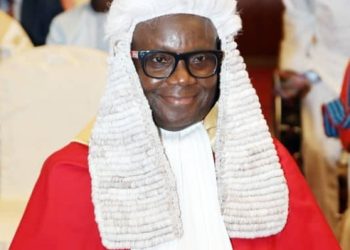
A Justice of the Supreme Court, Justice Kweku T. Ackaah-Boafo, has called for Ghana’s legal education reforms to place greater emphasis on building lawyers’ competence in customary law, warning that increasing the number of legal practitioners alone will not translate into improved access to justice.
In his address at the 13th Jurists’ Confab at the University of Cape Coast on June 25, Justice Ackaah-Boafo said that while the Legal Education Act, 2026, has expanded opportunities for professional legal training, the reforms risk falling short if graduates are not equipped to serve the legal needs of the majority of Ghanaians.
“Most of our people live their legal lives under customary law, which governs their land, their families, their inheritance, and their disputes, and it does so as a living system rather than a chapter in a textbook,” Justice Ackaah-Boafo said.
“A profession that grows in number but cannot competently serve the law under which the majority of Ghanaians actually live has widened access to a profession without widening access to justice.”
Justice Ackaah-Boafo believes that the country’s legal education reforms should ultimately be judged by how well they serve the public rather than by the number of lawyers they produce.
He observed that customary law remains central to the daily lives of many Ghanaians, governing issues such as land ownership, family relations, inheritance, and dispute resolution. Yet, he noted, the new legal education framework pays little attention to ensuring that future lawyers develop practical competence in that area.
“The new framework says very little about building genuine competence in customary law, and if we mean access as a duty to the public rather than a count of lawyers, that silence is one we will have to fill,” he said.
Justice Ackaah-Boafo argued that expanding legal education without strengthening lawyers’ understanding of customary law would leave many citizens without meaningful legal representation despite the increase in the number of practitioners.
He stressed that professional standards exist primarily to protect members of the public who depend on lawyers to safeguard their rights and interests.
“It is worth asking why we insist that a lawyer be well trained at all,” he said. “The honest answer has little to do with the dignity of the profession. Standards exist for those people.”
The Supreme Court justice urged policymakers and legal educators to address gaps left by the new legal education framework, including strengthening customary law training and increasing the pool of qualified lecturers capable of delivering practical legal education across accredited institutions.
He identified these as essential conditions for ensuring that Ghana’s legal education reforms achieve their intended objective of improving both access to legal training and access to justice.