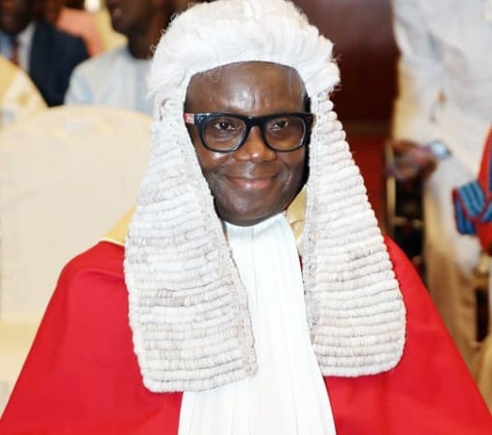
A Justice of the Supreme Court, Justice Kweku T. Ackaah-Boafo, has challenged the long-standing notion that Ghana must choose between expanding access to legal education and maintaining high professional standards, arguing that both objectives are essential to delivering justice.
He said the debate over legal education reforms has been wrongly framed as a contest between access and quality when, in reality, both serve the same public interest.
Delivering the keynote address at the 13th Jurists’ Confab at the Faculty of Law of the University of Cape Coast on the theme, Access Versus Standards: The Future of Legal Education in Ghana on June 25, 2026, Justice Ackaah-Boafo said the focus should shift from choosing one objective over the other to ensuring they are achieved simultaneously.
“I want to suggest to you that the small word in the middle of that phrase, the word ‘versus’, may be the part we have most misunderstood,” he said.
Justice Ackaah-Boafo explained that professional standards are not designed to protect the prestige of the legal profession but to safeguard the interests of ordinary citizens who depend on competent legal representation.
“It is worth asking why we insist that a lawyer be well trained at all,” he said. “The honest answer has little to do with the dignity of the profession, and everything to do with the people who will one day place their lives, their liberty, their homes, and their livelihoods in that lawyer’s hands.”
He said the public suffers when too few lawyers are available to provide legal services, but it is equally disadvantaged when legal practitioners are inadequately trained.
“The same public is failed by a profession kept needlessly small, because too few lawyers exist to serve them… and that public is failed again by a profession expanded without care, because it sends practitioners into the world who are not ready for the trust placed in them.”
Justice Ackaah-Boafo argued that this demonstrates that access and standards are complementary rather than conflicting goals.
“Access and standards turn out to be two duties owed to one and the same public, and a legal education that honours only one of them has simply chosen which group of vulnerable people it is prepared to fail,” he said.
He described Ghana’s ongoing legal education reforms as an opportunity to create a more inclusive system while preserving the competence and integrity expected of the legal profession.
The reforms, introduced under the Legal Education Act, 2026, ended the Ghana School of Law’s exclusive role in professional legal training by allowing accredited universities to offer the Law Practice Training Course and introducing a National Bar Examination for all aspiring lawyers.
Justice Ackaah-Boafo said the reforms would ultimately be judged not by the number of lawyers they produce but by whether they ensure that graduates are competent enough to earn and maintain the trust of the public.
“We answered a real wrong by opening the doors of this profession wider, and that was the right thing to do,” he said.
“The harder task is to make sure that everyone who now walks through those doors is worthy of the trust that waits on the other side.”