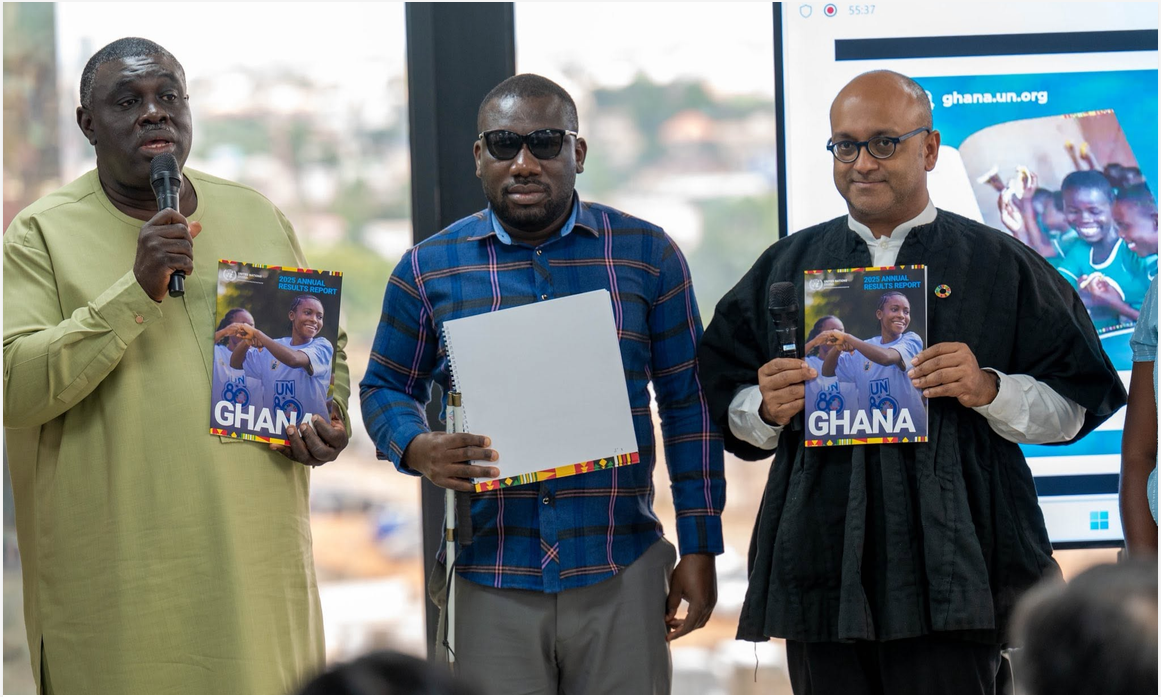
The United Nations (UN) Country Team in Ghana increased its programme delivery rate from 64% in 2024 to 80% in 2025, investing $113.3 million through 34 UN agencies to support a wide range of development initiatives across the country.
The investments were channelled through seven joint programmes implemented with 185 partners, focusing on poverty reduction and economic inclusion, health, education and social services, peace and governance, disability inclusion and gender equality, as well as climate finance and digital transformation.
According to the UN’s 2025 Annual Results Report, launched in Accra on Tuesday, June the interventions contributed to moving about 950,000 people out of multidimensional poverty between the fourth quarter of 2024 and the third quarter of 2025. Maternal mortality also declined from 310 to 234 deaths per 100,000 live births during the period.
The report highlighted progress in peace and security despite ongoing challenges, including the displacement of about 34,000 people due to the Gbinyiri conflict and more than 150 deaths linked to the Bawku conflict. It noted that immigration patrol coverage expanded from 12 kilometres to 22 kilometres as part of efforts to strengthen border security.
The UN also reported gains in digital literacy and peacebuilding, with 24,226 students receiving digital safety awareness training and 54 journalists trained in conflict-sensitive reporting. Peace messaging campaigns reached about 100,000 radio listeners and generated 1.5 million video views.
In the area of disability inclusion and gender equality, programmes implemented across Ghana’s 16 regions contributed to reducing child marriage prevalence from 19 per cent to 16.1 per cent, while a national disability data framework was developed to improve policy planning and implementation.
On climate action, the report said 24,152 tonnes of organic waste were diverted from landfills, while technical support was provided to develop Ghana’s disaster risk finance strategy, including a parametric flood insurance solution expected to protect about 4.9 million people.
Speaking at the launch, UN Resident Coordinator Zia Choudhury attributed the improved delivery rate to stronger coordination among agencies and enhanced accountability.
“We are improving our delivery rates because we are ready to deliver with greater discipline, greater reliability across the 34 agencies,” he said.
Mr Choudhury stressed that although the UN’s annual expenditure of more than $113 million may appear modest compared to national infrastructure spending, the resources were carefully targeted to maximise impact.
“The UN’s annual envelope of over $113m may not seem large compared to national infrastructure spending, but is managed with careful targeting, careful coordination, and careful accounting,” he said.
He cited improved access to quality education, nutrition support, increased access to seeds and finance for farmers, protection and economic opportunities for women and girls, and stronger climate resilience among communities as some of the key outcomes achieved through the programmes.
David Klotey Collison, Coordinating Director of Operations at the Ministry of Finance, said the results reflected the strength of the partnership between Ghana and the UN system.
“Over the past year, Ghana has made deliberate efforts to strengthen fiscal policy, optimise public investment and enhance domestic resource mobilisation, but international cooperation was necessary in achieving the country’s sustainable development goals,“ he said.
Mr Collison described the UN as a strategic partner in supporting essential services, social protection, climate resilience, economic transformation and peacebuilding efforts in Ghana and the wider sub-region.
He noted that the country’s development agenda was increasingly focused on transformation and resilience, emphasising the need for stronger collaboration, including through public-private partnerships, to build sustainable economic systems.
The Finance Ministry official expressed appreciation to the UN and its partners for their continued support and pledged to deepen cooperation to achieve greater development outcomes in the years ahead.
Source: GNA