Imagine a company that proudly announces record profits every year.
The shareholders applaud. The directors congratulate themselves. The newspapers celebrate the impressive figures.
There is only one small problem. The company is making those profits by selling its desks, chairs, computers, vehicles and even parts of its office building. Yet somehow, no one is recording the loss of these assets in the accounts.
Any accountant would call this madness. In Ghana, we often call it economic growth.
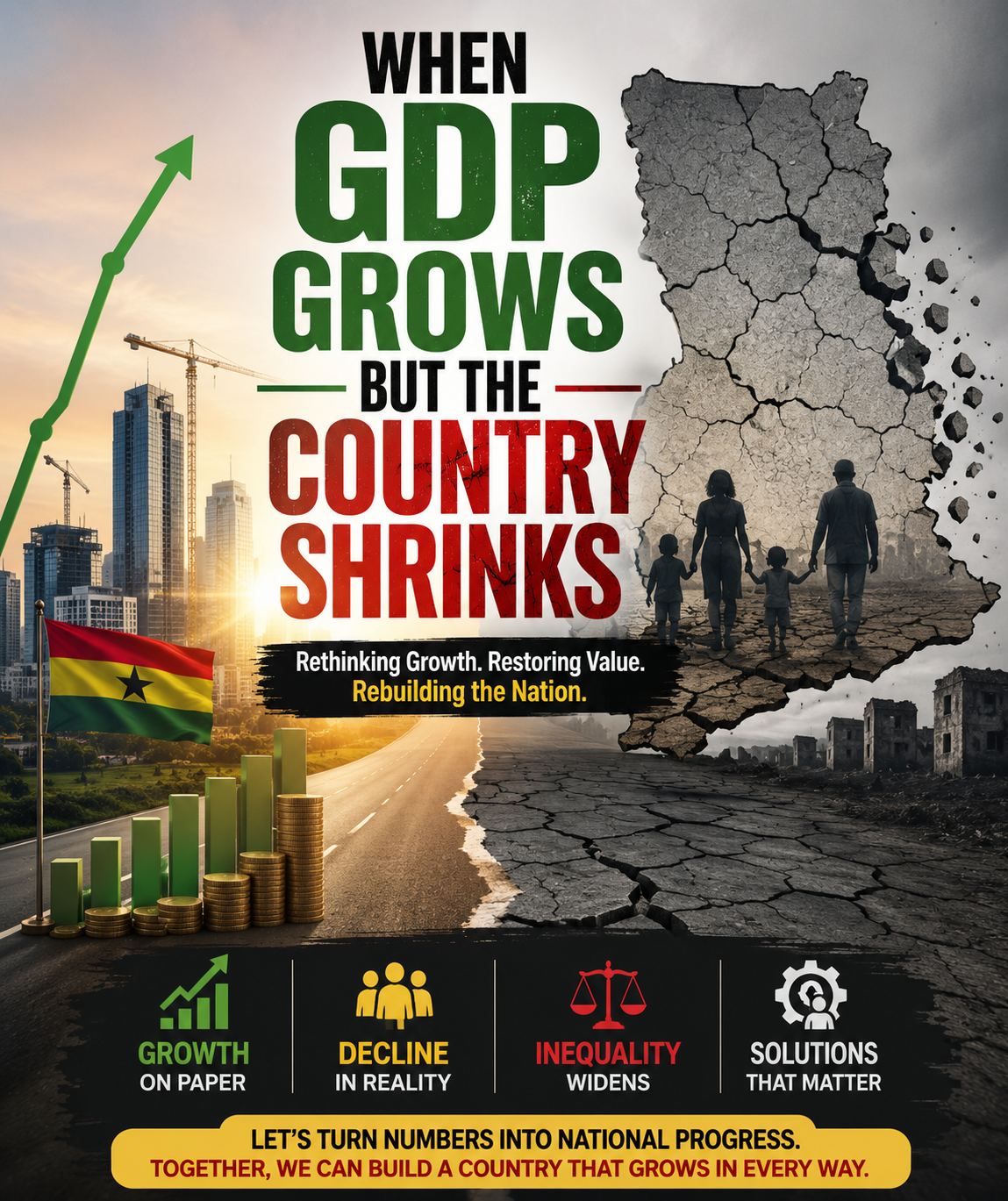
For decades, we celebrate increases in GDP driven by gold extraction, timber harvesting and other natural resource activities. The numbers look impressive. But unlike a well-run business, we rarely ask what is happening to the assets that generated those revenues in the first place.
When a company uses a machine, it charges depreciation because the machine loses value over time. When Ghana extracts non-renewable minerals, destroys forests, pollutes rivers or degrades fertile land, we largely count the income but conveniently forget the depreciation. We risk mistaking the consumption of national wealth for genuine economic progress.
It is an accounting miracle. Gold, extracted through both legal and illegal mining, leaves the ground forever. Forests destroyed through illegal logging may take decades or even centuries to recover. Rivers turn brown and somehow the national books still suggest we are getting richer. Yet, Ghana’s natural wealth is being depleted faster than it is being restored – and we are the poorer with regard to our total asset base.
Nature, however, has begun conducting its own audit. The recent rains in parts of the Central and Western Regions have revealed some interesting accounting adjustments. Forests that once absorbed water are gone. Rivers that once flowed freely are clogged. Wetlands that once acted as natural buffers have been degraded.
The result? Floods arrive to remind us that ecosystems perform valuable services even when they do not submit invoices.
Unfortunately, the bill eventually arrives anyway.
It arrives in the form of washed-out roads, damaged bridges, destroyed homes, disrupted businesses and reconstruction costs funded by taxpayers. It arrives when farmers face declining yields, when communities struggle for clean water and when future generations inherit fewer assets than the generations before them.
In accounting terms, Ghana may be one of the few entities that records revenue from selling its natural assets while largely ignoring the depreciation of the assets themselves. If any private company attempted this, auditors would have questions. Nature is beginning to ask some of its own.
Perhaps it is time for Natural Resource Accounting (NRA) to become more than an academic concept. NRA offers Ghana a more honest and sustainable measure of development. It helps policymakers understand whether economic growth is being achieved through genuine wealth creation or through the gradual depletion of irreplaceable natural assets. By incorporating natural capital into national accounts, decision-makers can better evaluate the true costs and benefits of economic activities and design policies that protect long-term prosperity.
It is simply common sense applied to a nation’s balance sheet. After all, a country cannot become wealthy by continuously liquidating its natural capital and calling the proceeds income.
True development is not measured only by what we extract today, but by what we leave behind for tomorrow.
For a country facing the twin challenges of resource dependence and environmental degradation, the question is no longer whether NRA is relevant. The more pressing question is whether Ghana can afford to continue measuring progress without it.
The rains, the floods and the disappearing forests are all saying the same thing: when you keep selling the furniture, eventually there is nowhere left to sit.
By: Benjamin Bright-Davies. The writer is the CEO of CashBack Capital