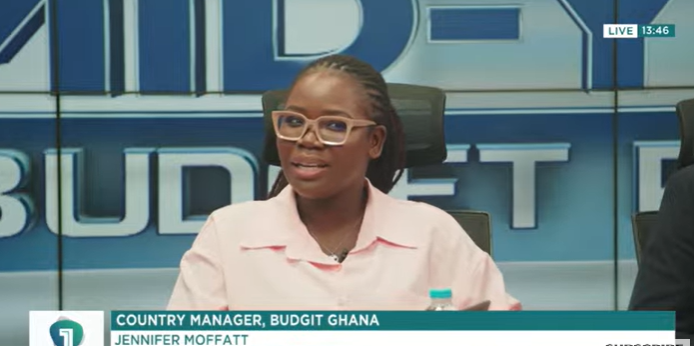
Country Manager for BudgIT Ghana, Jennifer Moffatt, has raised concerns over what she describes as inadequate funding for agriculture at the Metropolitan, Municipal and District Assembly (MMDA) level, despite government’s increased focus on the sector.
Speaking on Channel One TV ahead of the 2026 Mid-Year Budget Review, she noted that an analysis of local government budgets showed that allocations to agriculture appeared to be treated as an afterthought.
According to her, while the 2026 national budget placed significant emphasis on agriculture, the same priority was not reflected in the budgets of many MMDAs.
“When you were presenting the overview of the whole economy and I saw that agric was 4.0, I was not surprised. And my reason being that for our work that we analyse budgets, one of the key things we also do is to look at all the subnational level, the MMDA budgets.”
“You realise that the 2026 budget had a lot for the agriculture sector, but that is national. If you go to the MMDA budget and you check the amount they are allocating for agriculture, it is like an afterthought,” she said.
She pointed out that the trend appears to be widespread across various assemblies, a situation she believes could undermine Ghana’s dependence on agriculture for economic growth and food security.
She referenced the recent killing of eight Ghanaians who had travelled to Burkina Faso to purchase tomatoes, describing the incident as a reflection of the need for increased investment in domestic agricultural production.
“It actually hurts when you see that this economy, we depend so much on the agriculture sector and taking into consideration what happened to the women who had to go all the way to Burkina Faso to get tomatoes for our system and the kind of things that they met, when we actually have arable lands in the country that can do that.”
She urged government and local authorities to channel more resources into agriculture, arguing that increased investment in the sector could help reduce food inflation.
“If we are really going to set up as a people, we should stet up and really put more money in the agriculture sector as it is, which would also help reduce the food inflation as we see it.”