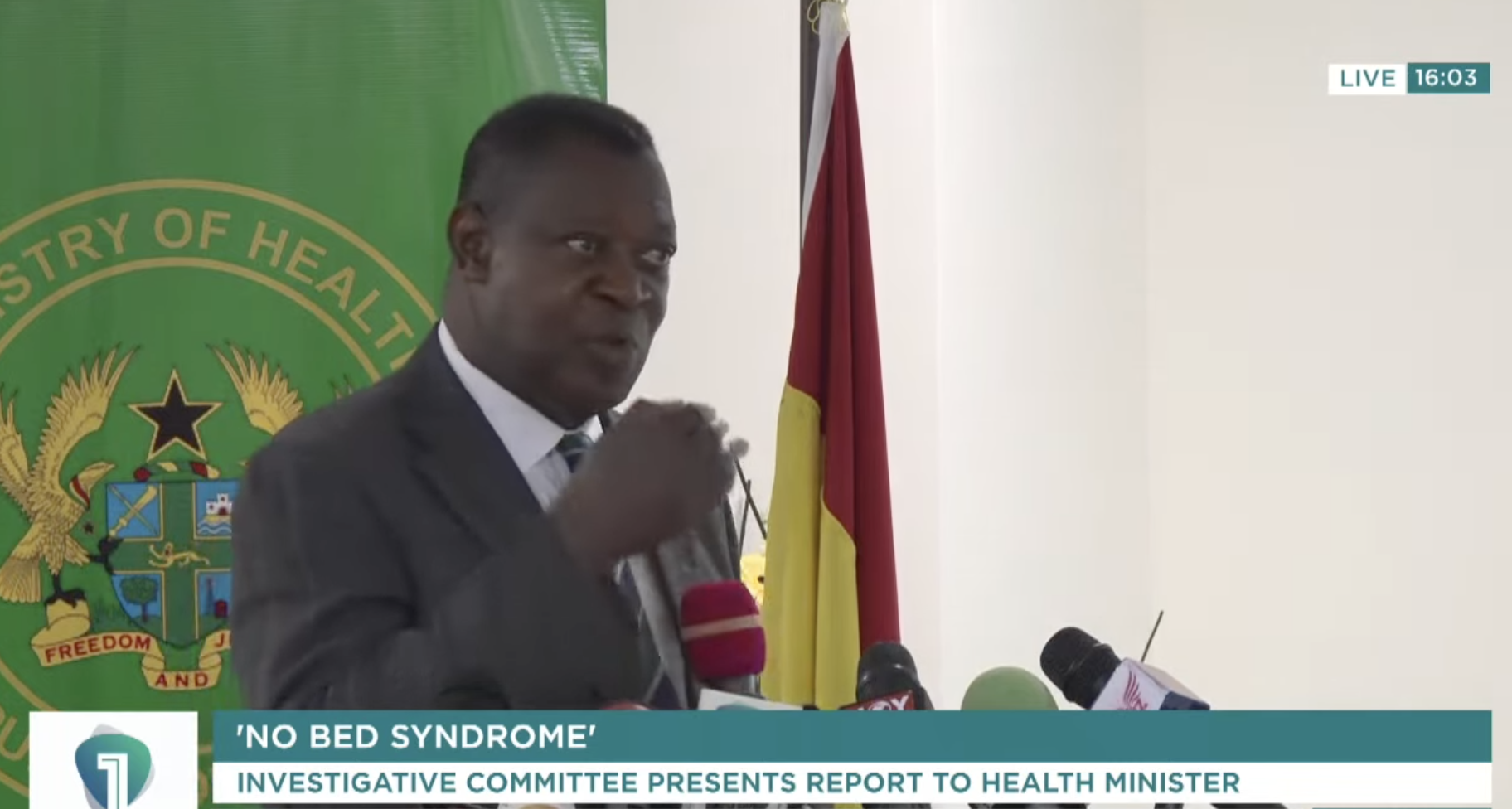
The committee set up to investigate the death of Charles Amissah has concluded that failure by the medical staff at the Police hospital, Greater Accra Regional Hospital, and the Korle Bu Teaching Hospital led to the death of the 29-year-old engineer on February 6.
Chair, Professor Agyeman Badu Akosa, presenting the key findings of the “No Bed Syndrome” Committee to the Ministry of Health in Accra on Wednesday, May 6, said the committee found that Amissah’s death was caused by exsanguination resulting from a severe upper right arm injury that damaged major blood vessels, including the axillary arteries and veins.
He stressed that the death could have been prevented at several stages of care if standard emergency interventions had been properly applied.
According to him, immediate compression and dressing of the deep laceration at the scene or during ambulance transport could have significantly reduced or stopped the bleeding.
He added that the administration of intravenous fluids in transit would have helped maintain blood volume and improve survival chances.
He further noted that equivalent life-saving measures, including intravenous fluids or whole blood transfusion, could have been administered at any of the receiving facilities to sustain the patient.
The committee found serious gaps in the national ambulance service response, including poor documentation of vital signs and limited clinical intervention capability. While ambulance crews were able to measure blood pressure and oxygen saturation, Prof. Akosa said they lacked the equipment and capacity to go beyond basic assessment.
He also highlighted equipment challenges, noting that some monitoring devices were not functional, which affected the ability to properly track the patient’s condition during transport.
Another key concern raised was the absence of a formal handover system and weak coordination across institutions, leading to delays and unclear transfer responsibilities.
The report revealed that the ambulance arrived at the Police Hospital with the patient still alive, but no effective triage or stabilisation was carried out. It left the facility after about 11 minutes.
A similar pattern was recorded at Ridge Hospital, where the ambulance again arrived with a live patient but departed after approximately 17 minutes without adequate emergency intervention.
At the Korle Bu Teaching Hospital, the committee found that despite the patient still being alive on arrival, no immediate stabilisation was undertaken. The ambulance crew was later redirected to the University of Ghana Medical Centre, but that instruction was not followed.
The patient eventually died in the ambulance roughly 70 minutes after arriving within the hospital environment.
Prof. Akosa said ambulance personnel also demonstrated inconsistencies in the recording and reporting of vital signs, and lacked training in basic life support, advanced cardiac life support, and advanced trauma life support. He described them as largely functioning as transport providers rather than emergency care responders.
The committee also made findings against several health professionals, stating that multiple clinicians failed to exercise appropriate clinical and ethical judgment by not attending promptly to the patient in a life-threatening condition.
Those cited include Dr Anne-Marie Kudowor at the Police Hospital, Dr Nina Naomi Eyram Adotevi at Ridge Hospital, Dr Ida Druant and Dr Genevieve Adjar at Korle Bu Teaching Hospital, as well as Miss Akosua B. Turkson, Miss Joy Daisy Nelson, and Ms Salamatu Alhassan Aidoo. The report alleges that in each case, failure to initiate immediate emergency care contributed to the fatal outcome.
In its conclusion, the committee stated that medical staff on duty across the three major hospitals failed to provide timely intervention, resulting in what it described as an avoidable death.
The findings form part of a broader report that also proposes systemic reforms aimed at strengthening emergency care delivery and addressing the long-standing challenges associated with hospital capacity and patient triage in Ghana.
The committee has therefore recommended sweeping disciplinary actions and far-reaching reforms to Ghana’s emergency healthcare system.
Read more below
Charles Amissah: Doctors, Nurses face disciplinary action – Committee recommends