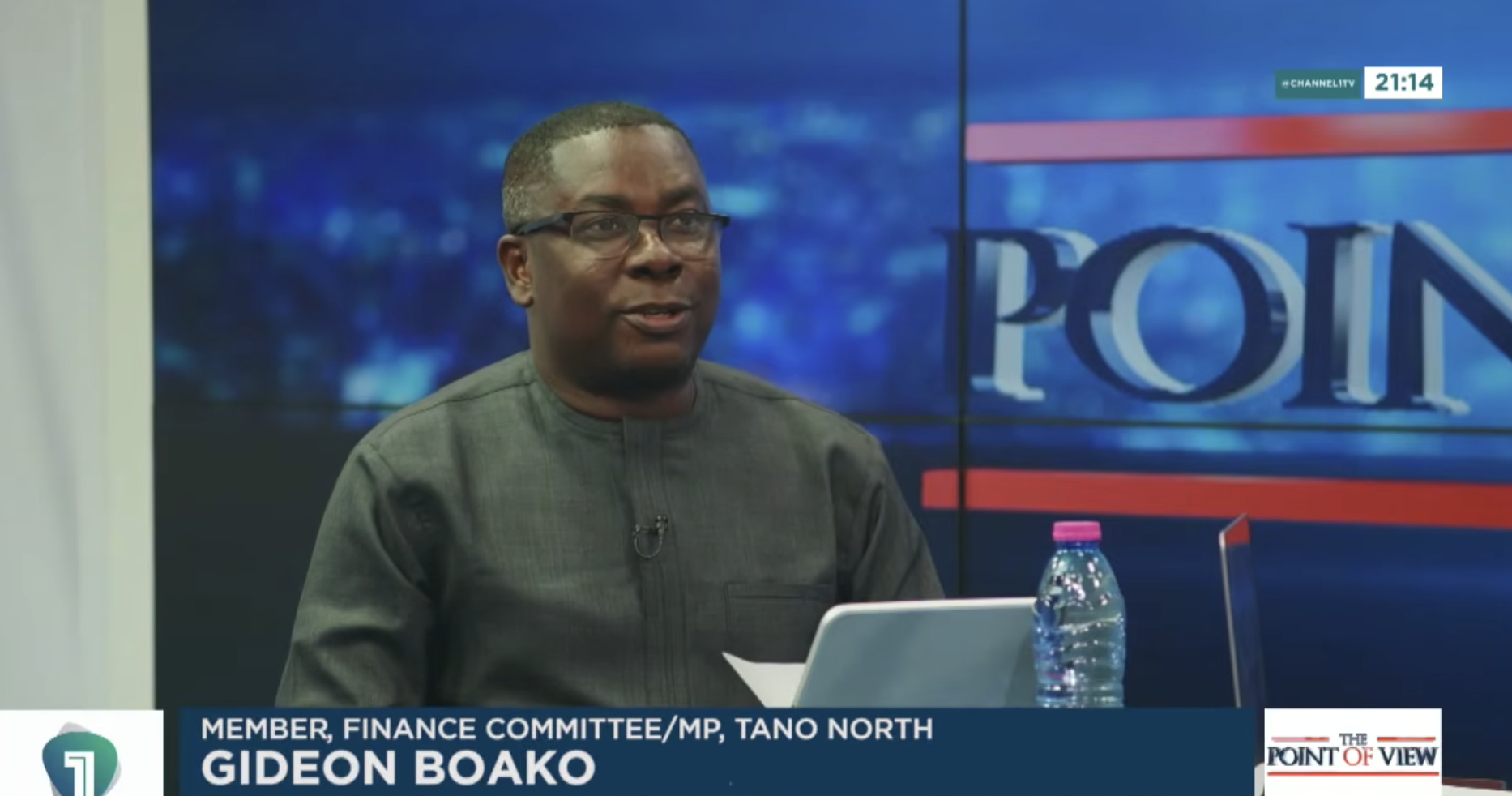
A Member of the Finance Committee of Parliament and MP for Tano North, Dr. Gideon Boako, has questioned the Bank of Ghana’s liquidity management strategy, criticising the central bank for issuing Open Market Operations (OMO) instruments at interest rates above its own policy rate despite easing inflationary pressures.
Speaking on The Point of View on Wednesday, May 6, 2026, Dr Boako argued that the central bank adopted an overly aggressive approach to mopping up liquidity, raising concerns about policy coherence and the pace of disinflation.
“….At a point, the central bank was issuing OMO at an interest rate over and above the policy rate. And I’m like, what is happening? Why are you issuing OMO at a rate above even your policy rate? So the central bank was in a hurry to mop up. And I’m like, where are you mopping up to? This sharp reduction in inflation. Inflation reduction is good. But let’s ask ourselves, the speed of the reduction, was it necessary?” he said.
The comments come amid growing debate over the Bank of Ghana’s 2025 financial performance after the central bank recorded a GH¢15.6 billion loss in its financial statements.
A significant portion of the losses has been linked to the cost of liquidity sterilisation through OMO operations, particularly the issuance of 14-day and 56-day OMO bills used to absorb excess liquidity from the banking sector.
The Bank of Ghana uses the short-term instruments as part of its monetary policy framework to manage money supply and stabilise inflation. In 2025, rates on the instruments closely tracked the Monetary Policy Rate, which ranged between 21.5 per cent and 27 per cent.
The 56-day OMO bill, in particular, became a major tool for active liquidity absorption, with the cost of the operations reaching GH¢16.73 billion in 2025 due to the high interest paid to commercial banks.
Dr Boako suggested that while reducing inflation is necessary, the speed and intensity of the central bank’s interventions may have imposed avoidable financial costs.
His remarks add to mounting scrutiny over the Bank of Ghana’s monetary operations and the broader impact of its anti-inflation measures on the central bank’s balance sheet.