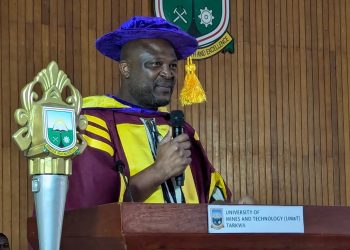
“The next generation of Ghana’s engineers would not be imported but created”. These were the words of the Member of Parliament for Ningo Prampram, Samuel Nartey George, at the launch of the Robotech Lab project recently at the University of Mines and Technology in Tarkwa.
Also, Ghana is at a technological crossroads and the decisions we make today will determine whether we become consumers of innovation developed elsewhere or creators of technologies that drive our growth and competitiveness. In search of solutions to some of the global challenges, the SDGs emerged as a blueprint to guide nations towards a sustainable development path.
In addition, it has been the expectation of many that in a triple-helix approach, academia, government and industry must be on a coalition course to bring about the needed transformation, especially in technological advancement to offer solutions to some of our challenges in health, energy, agric, and mining, among others. One of such impactful research and innovations is the development of a fully functional Smart Sanitary Pad Vending Machine.

The objetive of the groundbreaking development are to ensure dignified and emergency access to hygiene products for uninterrupted learning, as well as gender mainstreaming and inclusivity. The SSPVM Research across Sub-Saharan Africa consistently indicates that inadequate access to menstrual hygiene products contributes to absenteeism and academic disruption. In Ghana, this gap is particularly evident.
A 2024 report by SEND Ghana found that 63% of basic schools nationwide lack adequate WASH (Water, Sanitation, and Hygiene) facilities. It was thus timely and a welcoming intervention when the Government of Ghana, under President John Dramani Mahama, launched the National Sanitary Pad Distribution Programme on 24 April 2025 with an allocation of GH₵292.4 million targeted at primary and secondary schools.
To complement the effort of His Excellency, a team of students under the supervision of Dr Emmanuel Effah, Head of Applied Science, Computer Science and Engineering (ASCSES), has developed and tested the SSPVM prototype designed to provide registered female students with immediate, free, and dignified emergency access to sanitary pads and hygiene wipes, at any hour, without requiring human intervention.

The machine integrates embedded systems engineering with IoT-enabled remote monitoring to deliver a secure, low-cost, and scalable dispensing solution. The core processing unit is an ESP32 microcontroller, selected for its dual-core architecture, built-in Wi-Fi and Bluetooth capabilities, and suitability for always-on, campus-deployed hardware applications. Student authentication is handled through a biometric fingerprint scanner paired with a physical keypad, providing dual-layer identity verification.
This mechanism ensures accountability while preserving user privacy: no usage data is linked to identifiable personal records beyond quota enforcement while an LCD display provides real-time user feedback during each interaction. The dispensing logic is governed by an algorithmically enforced quota system. Each authenticated student is allocated a maximum of two units per dispensing event and no more than five units per calendar month.
This constraint is designed to ensure equitable distribution across the female student population, particularly during high-demand periods such as examinations. The system’s IoT connectivity enables remote inventory monitoring, low-stock alerts, and tamper detection, providing administrators with data-driven insights for procurement and maintenance planning. Access is entirely free of charge, operating on a university-subsidised model.
The enclosure is designed for discreet installation in female washrooms and student welfare corridors. Finished SSPVM alignment with the Sustainable Development Goals (SDGs)The SSPVM is designed with reference to three of the United Nations’ Sustainable Development Goals. SDG 3 calls to “ensure healthy lives and promote well-being for all at all ages” the SSPVM advances this by providing uninterrupted access to hygienic menstrual products. SDG 4 calls to “ensure inclusive and equitable quality education and promote lifelong learning opportunities for all” the SSPVM supports this by removing a physiological barrier that currently disrupts academic continuity for female students.

SDG 5 seeks to “achieve gender equality and empower all women and girls” the SSPVM addresses this by affirming that female students are entitled to the same uninterrupted academic environment as their male peers.
Relevance to Ghana’s National Policy Framework At the national level, the SSPVM complements Ghana’s evolving menstrual health policy without duplicating it. Whilst the government’s Free Sanitary Pads initiative targets pre-tertiary institutions, tertiary students remain outside its current scope.
The SSPVM offers a replicable, technology-driven model for extending last-mile menstrual product delivery to university campuses. It also operationalises Ghana’s WASH in Schools guidelines at the tertiary level, addressing a structural gap that national policy has not yet systematically resolved.