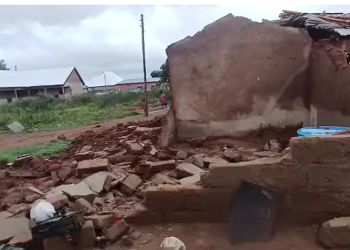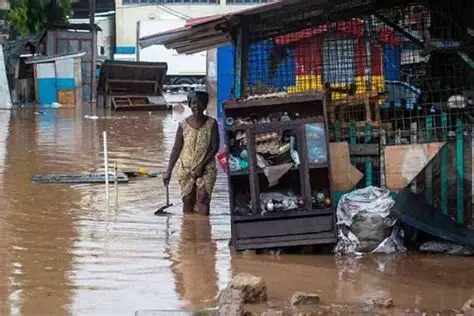
When the rain descends, the way it always does in communities from the banks of the Odaw River in Accra to the low-lying settlements of the Volta Region, the relentless, filth-laden deluge transforms the nation’s usually frantic arteries into corridors of stagnation and despair.
The catastrophe of June 3, 2015, which affected over 53,000 people, claimed more than 150 lives through a devastating flood-and-fire disaster at the Kwame Nkrumah Circle in Accra, should have been the absolute turning point and marked Ghana’s ESG reckoning.
Yet, a decade and more later, floodwaters that do not discriminate between a homeowner’s sanctuary and a squatter’s shelter, continue to render both refugees. Traders watch their working capital rot while corporate towers and schools shutter, leaving a shared narrative of loss long after the waters recede.
By evening, news broadcasts echo the term “natural disaster.” Yet true natural disasters are anomalous acts of nature, not clockwork tragedies. Official archives of the National Disaster Management Organization (NADMO) trace the footprint of this calamity far back, noting that urban inundations have plagued Accra with relentless regularity since the first major recorded deluge in 1935.
Over the decades, recurring surges have claimed over 3,000 lives and displaced upwards of 700,000 people nationwide, with the capital bearing the heaviest brunt. A disaster that repeats with such regularity is no act of nature.
Why has this crisis stretched on for nearly a century?
Because interventions have historically been reactive, short-lived, and disconnected from genuine structural accountability as typified by findings in the official Performance Audit Report of the Auditor-General on the Provision of Flood Control Drains by the Hydrological Services Department of the Ministry of Works and Housing. The audit revealed that between 2015 and 2019, only 12.2 kilometers of planned storm drains (just 11.1 % of targets) were built while over GH¢117 million was expended.
Blaming the heavens is a cowardly deflection. This crisis is sustained by systemic corruption: permits are traded for the arrogant sprawl of engineered defiance that erases natural buffers, while compliance is dismantled by bribery. Choked on thick, indigestible sludge, our drainage veins leave the rain nowhere to go. Every flooded street is a monument to the manufactured disregard of Environmental, Social, and Governance (ESG) standards for profit.
For some time now, ESG frameworks have been treated as bureaucratic paperwork for annual reports. But the rising tide does not care about corporate disclosures. This is the moment to realize ESG is not a box-ticking exercise, but the practical resilience safeguard our environment needs.
Environmental (E) Realism: Moving past tokenistic green initiatives, firms, especially banks, must actively finance and implement nature-based solutions that are aimed at restoring wetlands, protecting urban green spaces, and enforcing sustainable drainage systems to rebuild the natural buffers that absorb catastrophe. Backing circular waste management ensures that plastics stop choking our drainage arteries.
Social (S) Protection: Recognizing the human element means shielding vulnerable populations, such as informal traders and low-income households, by investing in resilient community infrastructure and accessible financial safety nets like parametric insurance, preventing recurring floods from cementing cycles of poverty.
Governance (G) Integrity: Governance must transition from a compliance checklist to a weapon of accountability. Financial institutions and regulatory bodies must integrate rigorous climate-risk screening into credit appraisals and project approvals, rendering environmentally reckless construction on floodplains entirely unbankable.
Marking a decisive turning point in this governance and environmental revival, the government has directed the immediate revocation of Executive Instrument (E.I.) 144 (as amended by E.I. 234), officially restoring the Achimota Forest Reserve to its full protected status and shielding Accra’s last major urban ecological lung from commercial encroachment.
Concurrently, the repeal of Legislative Instrument (L.I.) 2462 has closed the legal gateway that once threatened over 25 forest reserves and Globally Significant Biodiversity Areas like the Atiwa Forest, halting destructive mining licenses and safeguarding vital national green belts.
Beyond these legislative safeguards, broader national enforcement operations have intensified protection across forest reserves nationwide. Coupled with the reemergence of national sanitation days to tackle municipal waste management at a grassroots level, these bold policy corrections prove that there is an awakening to align with rigorous ESG principles.
Although this awakening has arrived far too late for the thousands who have suffered over the decades, it marks an essential and long-overdue stride toward systemic redemption.
The author is an ESG enthusiast and works with the Sustainability and Social Impact Department at the Ghana Export-Import Bank.