Ghana has made significant strides in education and digital transformation. Yet, one critical gap remains that women are still underrepresented in STEM (Science, Technology, Engineering, and Mathematics).
Addressing this imbalance is not just a matter of equality; it is essential for innovation, economic growth, and inclusive development.
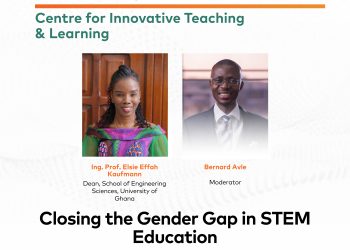
In the April edition of EdTech Mondays, host Bernard Avle sat down with Ing. Prof. Elsie Effah Kaufmann, Dean of the School of Engineering at the University of Ghana, to discuss practical solutions to increase female participation in STEM.
Understanding the Gender Gap in STEM
“There is a leaky pipeline. The numbers keep getting lower and lower as you go higher.” — Ing Prof. Elsie Effah Kaufmann said.
Despite the progress made so far, women remain underrepresented in STEM fields across Ghana and globally. Currently, only about 25% of Ghana’s technical workforce is made up of women, and in engineering, the numbers are even lower.
This gap highlights the need for greater investment in opportunities, mentorship, and support systems that encourage more girls and women to pursue and thrive in STEM careers.
The disparity becomes even more visible at higher levels of education and leadership, creating what Ing. Prof. Elsie Effah Kaufmann describes as a “leaky pipeline.” While more girls are entering STEM education, only a few continue into long-term careers, senior positions, or decision-making roles in the field.
Addressing this challenge requires sustained action to ensure women are not only welcomed into STEM but also supported to advance and lead.
Watch Prof. Elsie Effah Kaufmann speak on the widening gender gap in Engineering
The Role of Early Exposure in STEM Education
One of the most effective ways to increase female participation in STEM is through early exposure.
Encouraging girls to explore science and technology from a young age through hands-on activities, experiments, and interactive learning can significantly shape their interest and confidence.
As highlighted in the discussion, making STEM practical, engaging, and relatable is key to sustaining interest among young learners.
How EdTech is Transforming STEM Education
EdTech (Education Technology) is playing a critical role in bridging the gender gap in STEM education in Ghana and across Africa. EdTech by addressing traditional teaching limitations; It helps manage large classrooms by providing personalised attention, offers individualised learning experiences that allow students to grasp complex concepts at their own pace, and increases flexibility through remote access to materials.
Ing. Prof. Elsie Kaufmann explains how EdTech can help bridge the gender gap.
Why Representation Matters
Representation plays a powerful role in shaping aspirations.
Through her work as an academic leader and public figure, Elsie Effah Kaufmann exemplifies what is possible for women in STEM. Her visibility helps challenge stereotypes and inspires young girls to pursue careers in science and technology.
When girls see women thriving in STEM, it expands their vision of what they can achieve.
Strategies to Close the Gender Gap

Closing the gender gap in science and technology requires intentional planning and execution.
Early Education: Start at the basic level using hands-on tools like science kits to foster curiosity and problem-solving.
Digital Accessibility: Improve the affordability of digital tools and invest in accessible mobile-based programs for young women.
Higher Education Policies: Adopt affirmative action, such as the University of Ghana’s adjusted engineering requirements, to boost female participation and success.
Support and Environment: Provide mentorship, robotics competitions, and faculty training to prevent discouragement and build student confidence.
These strategies must be implemented intentionally and consistently to drive long-term impact.
Watch Ing. Prof.Elsie Kaufmann explain these strategies
Closing the gender gap in STEM is not a challenge any single institution can solve alone; it requires a coordinated, ecosystem-wide effort. Real progress happens when key players work together: educational institutions shaping talent, governments creating enabling policies, industry providing opportunities, development partners offering support, and EdTech innovators expanding access.
Platforms like EdTech Mondays are helping to bridge these gaps, creating space for dialogue, collaboration, and shared action. By connecting stakeholders and aligning efforts, they are not just sparking conversations but driving meaningful change toward a more inclusive STEM future.
Watch the Full Episode
Missed the live show? Catch up on this powerful conversation with Bernard Avle and Elsie Effah Kaufmann as they explore practical ways to close the gender gap in STEM.
Watch the full episode now and share your thoughts in the comments section.
Stay Engaged: EdTech Mondays continues to facilitate these high-stakes discussions on the last Monday of every month. Join us as we navigate the path forward together.
#EdTechMondays #EdTechMondaysGhana #WomenInSTEM #MastercardFoundation