The Bank of Ghana has maintained its monetary policy rate at 14%, citing heightened global uncertainty, renewed inflationary risks and the need to assess the potential impact of escalating geopolitical tensions on the domestic economy.
The decision was taken unanimously by the Monetary Policy Committee (MPC) at its 131st regular meeting held from July 20 to 22, 2026.
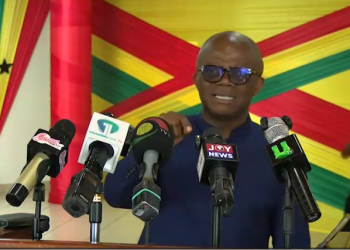
Announcing the decision at a press briefing in Accra, Governor Dr. Johnson Pandit Asiama said the current policy stance remains appropriate to guide inflation towards the Bank’s medium-term target band while allowing policymakers time to assess the impact of renewed conflict in the Middle East.
“Potential upward adjustments in utility tariffs together with escalating geopolitical tensions in the Middle East and the associated increase in crude oil prices present upside risks to the inflation outlook.
“On the downside, continued fiscal consolidation and an appropriately calibrated monetary policy stance should help moderate these risks going forward. Now, given these considerations the committee the MPC, by a unanimous decision, maintained the monetary policy rate at 14.0 percent.
The committee judged that the current policy stance remains appropriate to guide inflation into the medium-term target band while allowing time to assess the evolving geopolitical developments and their potential impact on the domestic economy,” he said.
The decision comes as global oil prices have risen above US$85 per barrel following the renewed escalation of conflict and the closure of the Strait of Hormuz.
According to the Governor, the development, coupled with disruptions to global trade routes, has reignited volatility in energy markets and could further slow the pace of global disinflation.
Stronger economic activity
The MPC noted that Ghana’s economy continued to expand strongly during the first quarter of 2026, with real GDP growth reaching 6.4%, compared with 6.2% in the same period a year earlier.
The Bank’s Composite Index of Economic Activity also recorded annual growth of 13.4% in May 2026, up from 4.4% a year earlier.
The improved performance was supported by stronger private sector credit, international trade activities, industrial production and tourist arrivals.
Private sector credit growth accelerated sharply to 41.2% in June 2026, compared with 8.6% in June 2025. In real terms, credit growth stood at 34.1% year-on-year.
The easing cost of credit also supported economic activity, with average lending rates falling to 15.6% from 27% a year earlier.
External buffers remain adequate
The external sector also recorded strong performance in the first half of the year, supported by robust export earnings from gold and cocoa.
The trade surplus rose to US$8.8 billion, from US$5.8 billion in the corresponding period of 2025, while the current account surplus expanded to US$5.1 billion from US$4.1 billion.
However, gross international reserves declined to US$12.9 billion at the end of June, equivalent to five months of import cover, from US$13.8 billion, or 5.7 months of import cover, at the end of December 2025.
The decline was attributed largely to elevated energy-related payments linked to the Middle East conflict.
Despite the reduction, Dr. Asiama said the current reserve position provides adequate buffers for the economy to withstand external shocks.
The cedi, meanwhile, came under pressure in May but has since recovered. As of July 17, 2026, the currency had cumulatively depreciated by 9.5% against the US dollar during the year.
The MPC said continued fiscal consolidation and an appropriately calibrated monetary policy stance should help moderate inflationary risks.
The Bank of Ghana’s next MPC meeting is scheduled for September 22 to 24, 2026, with the policy decision expected on September 24.